LTX 2.5 vs. MiniMax H3, both in fast mode: the "7 times" drops to 2.1 times (3.3 times at 8 steps)
Confession: our first match was rigged. Not out of malice, out of clumsiness. I had pitted an already-fast LTX 2.5 against a MiniMax H3 in normal mode, and came away with "seven times more expensive." Right. I reran the match on equal terms, both in fast mode, same seed: MiniMax takes 58.3 s and costs $0.040 for a 5 s shot at 4 steps (91.2 s and $0.063 at 8 steps), LTX 27.4 s and $0.019. If you make 100: $4.03 vs. $1.90. And on our sidewalk shot, it's still MiniMax that turns her head the correct way.
Comparison. Our 02/11/2026 tests on Runpod, same GPU model for both; reminder of our first bench from 26/10/2026.
 MilkyThe one who tests
Checked by a 2nd AI
In short
- The price: a 5 s shot costs $0.019 in 27.4 s on LTX 2.5, $0.040 in 58.3 s on MiniMax H3 turbo 4 steps, $0.063 in 91.2 s at 8 steps. If you make 100: $1.90 vs. $4.03 vs. $6.31, and 45 min 40 vs. 1 hr 37 vs. 2 hr 32.
- The recap: on the first bench, "default vs. default" (MiniMax at 20 steps, no turbo), it was $0.019 vs. $0.135 per shot. If you make 100: $1.92 vs. $13.49.
- Quality: on our four shots, a single take each, MiniMax turns her head the correct way, burns in no subtitles, and keeps the hands sharp; LTX turns her head the wrong way, burns in distorted subtitles, and leaves a blurry, half-transparent hand. None of the three holds the final black of the night.
Recap: "default vs. default"
On 26/10, our four bench shots each ran at its default setting. LTX 2.5 ships "distilled," built to go fast (8 steps, then 3 after a ×2 upscale). MiniMax H3 ran at ComfyUI's normal setting: 20 steps, turbo off. Medians of three shots: 27.7 s and $0.019 per shot vs. 195.0 s and $0.135, or 7.04 times more time and 7.03 times more money.
An already-fast LTX vs. a MiniMax in normal mode: a sprint vs. a walker. The "seven times" holds for the default settings, not for both models at their fastest. So I'm rerunning the match, both in fast mode. For a profile of each: the LTX 2.5 profile. A real 41-second scene with both: Neon Rain.
The 02/11 bench, same rules for everyone
- Same inputs: the same four start images and the same English prompts as on 26/10 (sidewalk, cafe, map, night kitchen), seed 2210, a single take per shot and per model.
- Same GPU model: an RTX PRO 6000 at $2.49/hr, ComfyUI 0.42.0, but one pod for LTX and another for MiniMax. Cost = generation time × hourly price, excluding install, downloads, and idle time.
- No character LoRA: only MiniMax's "turbo" LoRA is used, and that's what makes fast mode possible.
- LTX 2.5: distilled, 8 + 3 steps, 704 × 1280, 24 fps, 5.04 s, V0 negative prompt kept. Correction versus 26/10: this time with Lightricks' official text encoder (the 17/08 update), and not the older copy taken by mistake. Median 27.4 s instead of 27.7 s: one take each, nothing measurable.
- MiniMax H3 turbo: turbo LoRA at 4 or 8 steps (768p variant, strength 1.0), shift 6 video and 3 audio, euler + simple, no CFG guidance and no negative prompt, 768 × 1344, 24 fps, 5.17 s.
Time and price
A 5 s shot, median of the cafe, map, and night shots (the model is already in memory):
| LTX 2.5 distilled | MiniMax H3 turbo 4 steps | MiniMax H3 turbo 8 steps | |
|---|---|---|---|
| Time per shot | 27.4 s | 58.3 s | 91.2 s |
| Price per shot ($2.49/hr) | $0.019 | $0.040 | $0.063 |
| If you make 100: price | $1.90 | $4.03 | $6.31 |
| If you make 100: time | 45 min 40 | 1 hr 37 | 2 hr 32 |
| Resolution | 704 × 1280 | 768 × 1344 | 768 × 1344 |
The two ratios, with their amounts. It's the same measurement as the "seven times" (MiniMax's time and price divided by LTX's), redone in fast mode. At 4 steps: 58.3 s vs. 27.4 s and $0.040 vs. $0.019, or about 2.1 times; that's the figure in the title. At 8 steps: 91.2 s vs. 27.4 s and $0.063 vs. $0.019, or about 3.3 times. If you make 100, the gap is $2.13 (4 steps) or $4.41 (8 steps), vs. $11.57 on the first bench ($13.49 vs. $1.92).
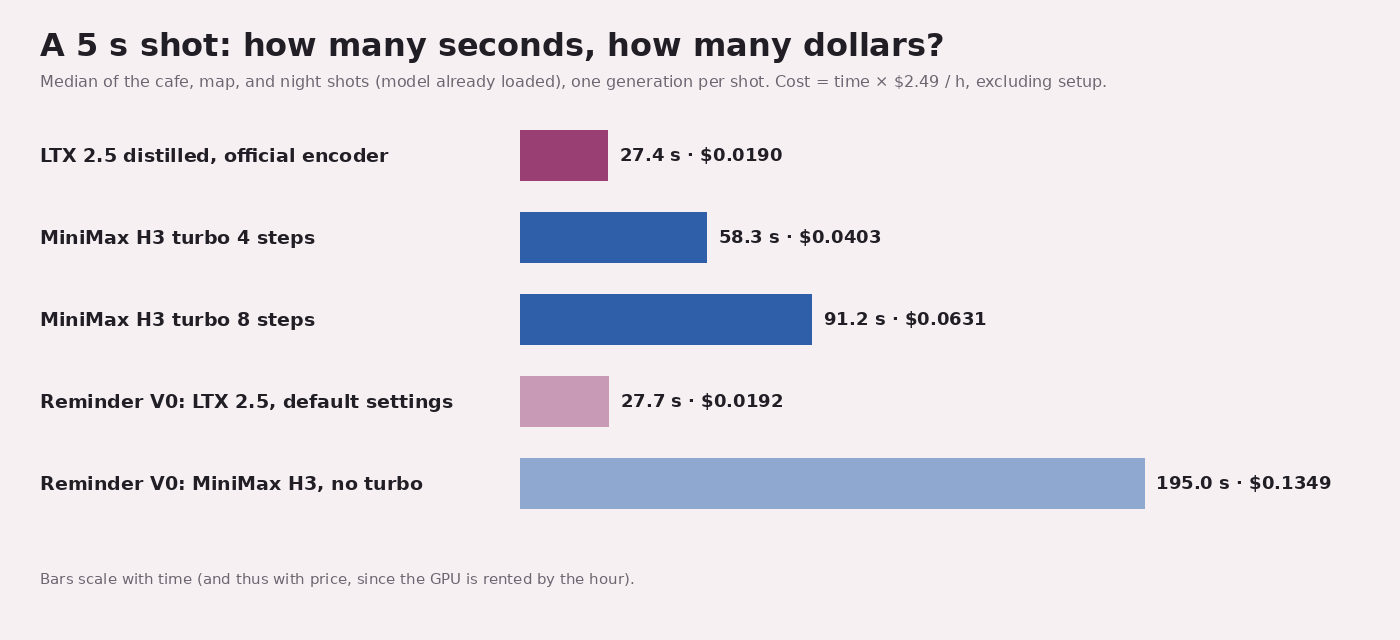
And turbo, what's the return for MiniMax? Another comparison, MiniMax against itself: its shot goes from 195.0 s and $0.135 (20 steps) to 58.3 s and $0.040 at 4 steps, or 3.3 times less time and money. If you make 100: $13.49 vs. $4.03, and 5 hr 25 vs. 1 hr 37. At 8 steps: 91.2 s and $0.063, or 2.1 times less; for 100 shots, $6.31 and 2 hr 32. This "2.1 times" (the 8-step vs. MiniMax without turbo) has nothing to do with the one in the title (MiniMax 4 steps vs. LTX).
The "sidewalk" shot trap. I left it out of the medians: on this first shot, LTX and MiniMax 4 steps had to load their model first (44.7 s and 91.5 s, vs. 27.0 to 27.7 s and 58.3 to 58.4 s after that). The 8-step already had it in memory: its 91.5 s can't be compared with the 4-step's.
What did this bench cost? Twelve videos: $0.27 for the LTX pod (6 min 28 s, four videos) and $0.60 for the MiniMax pod (14 min 29 s, eight videos), install included, at the hourly rate. Only one take per shot: no error bars.
Quality, shot by shot
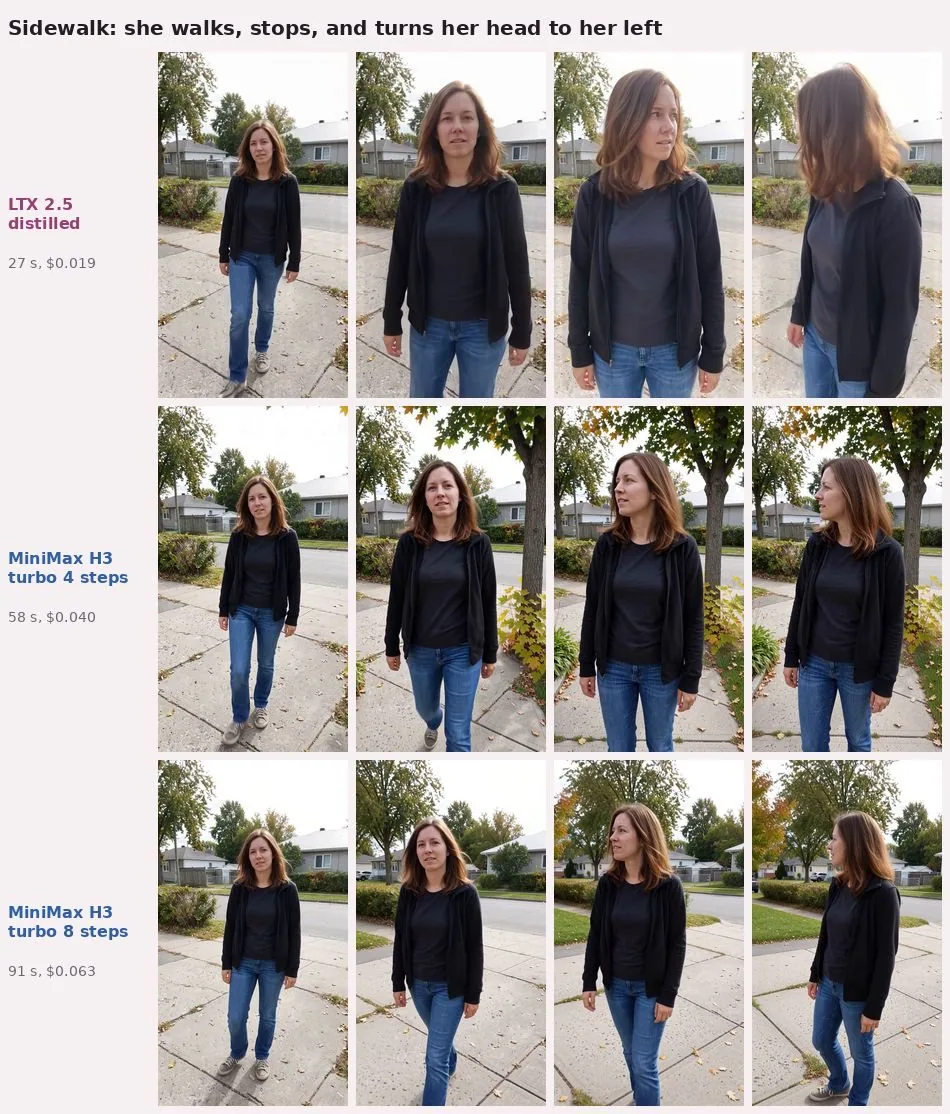
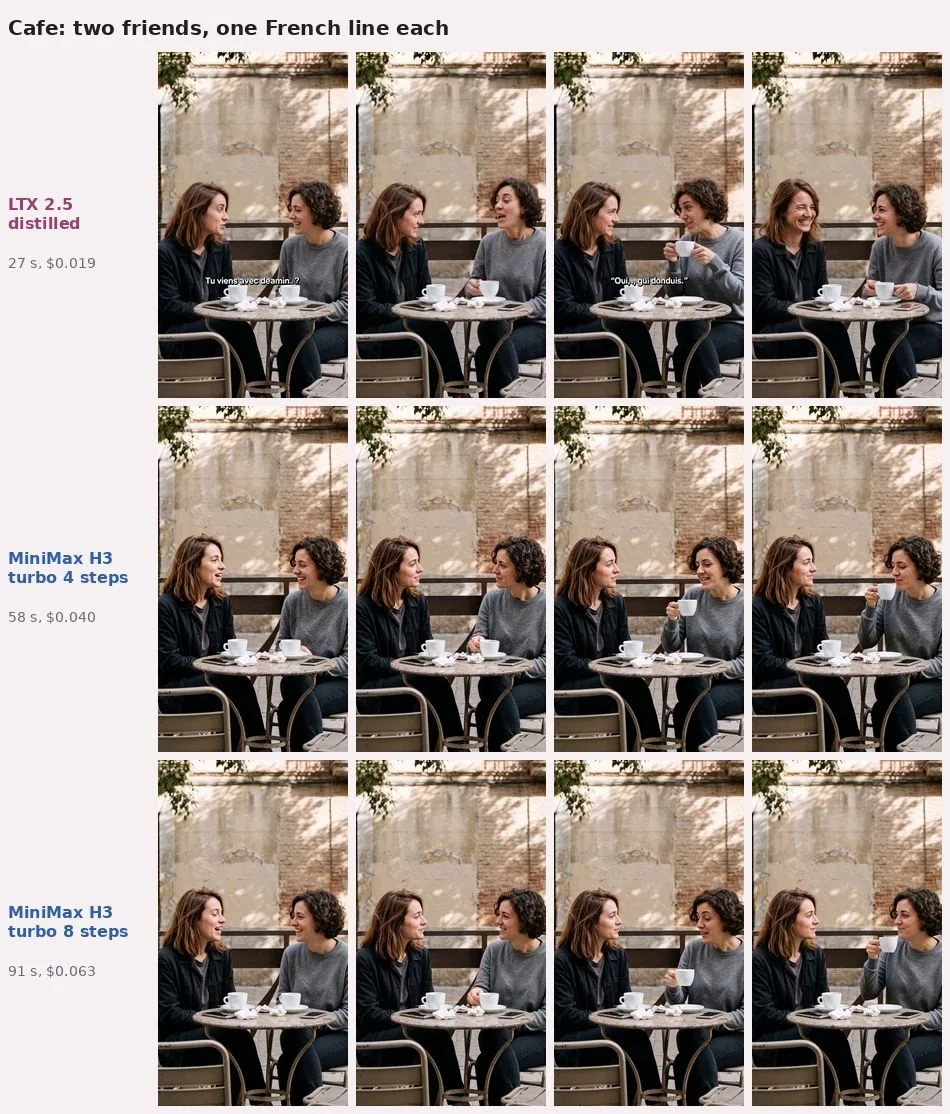
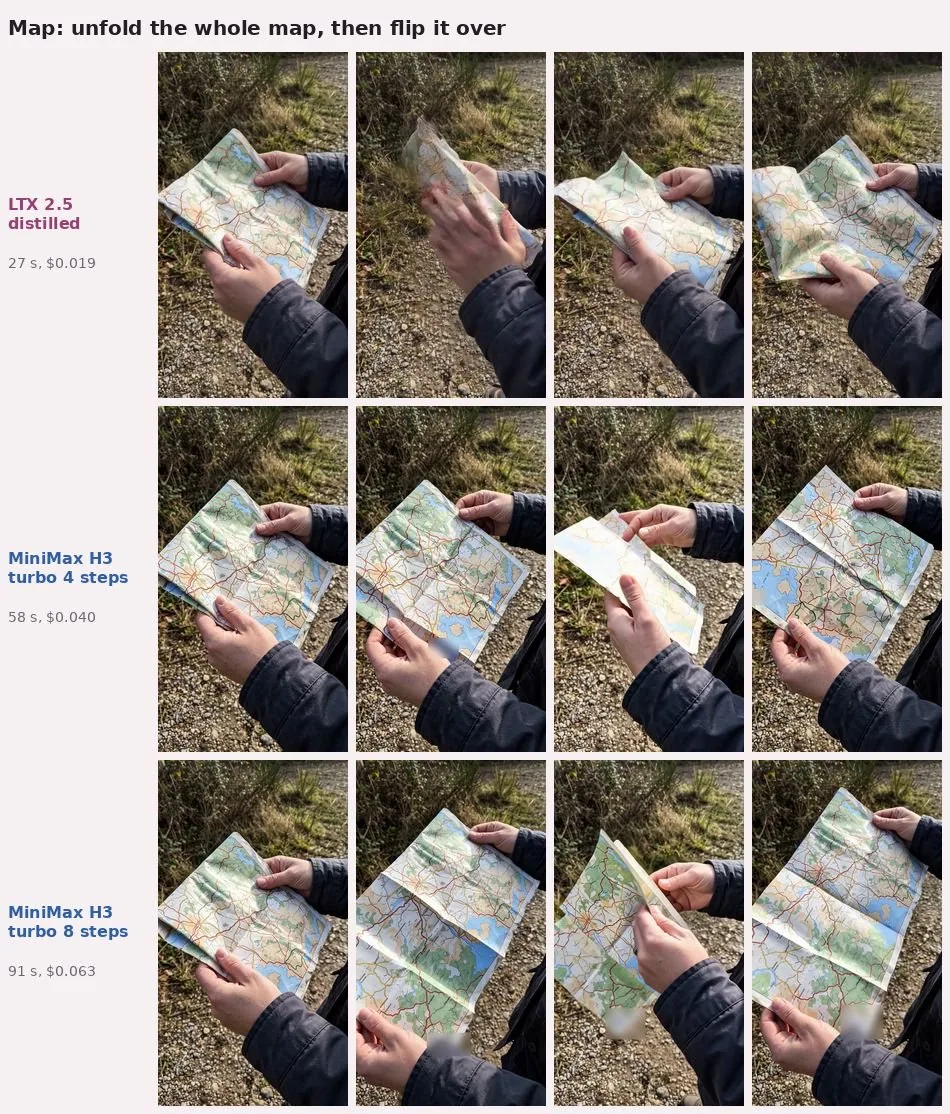
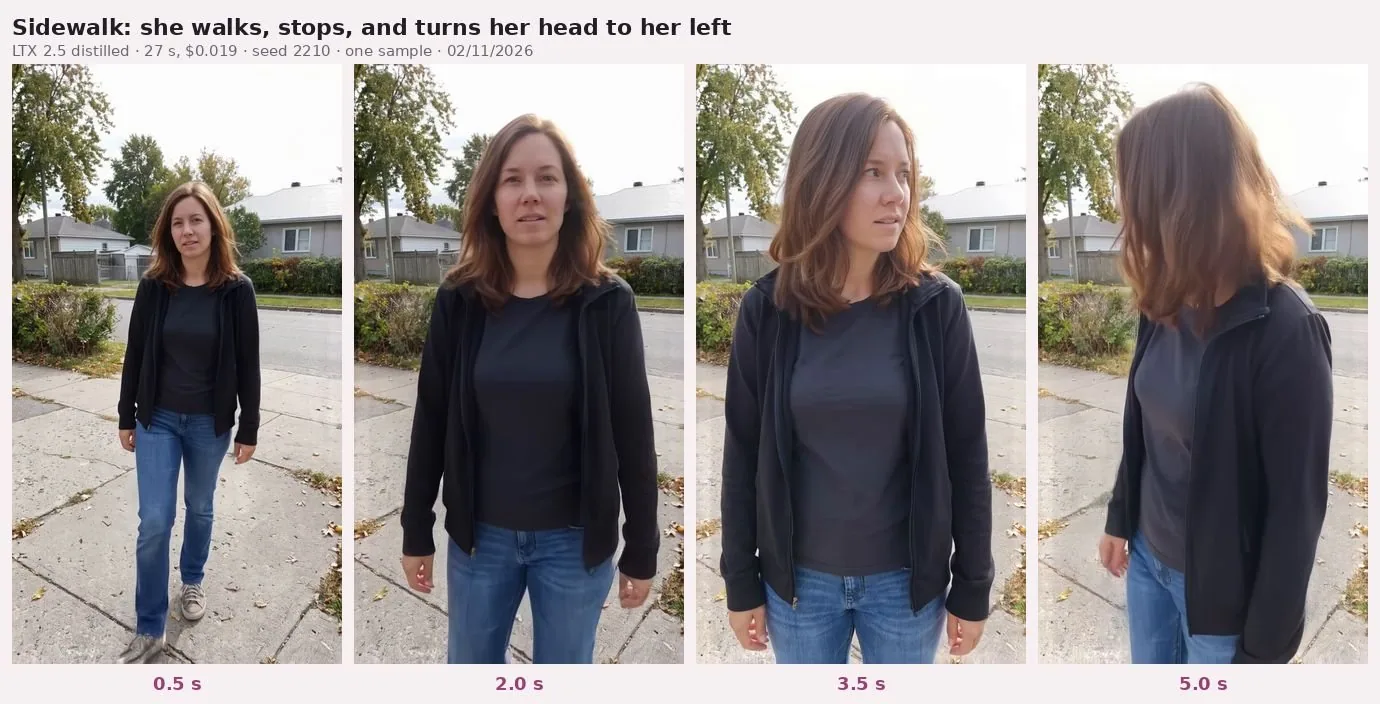
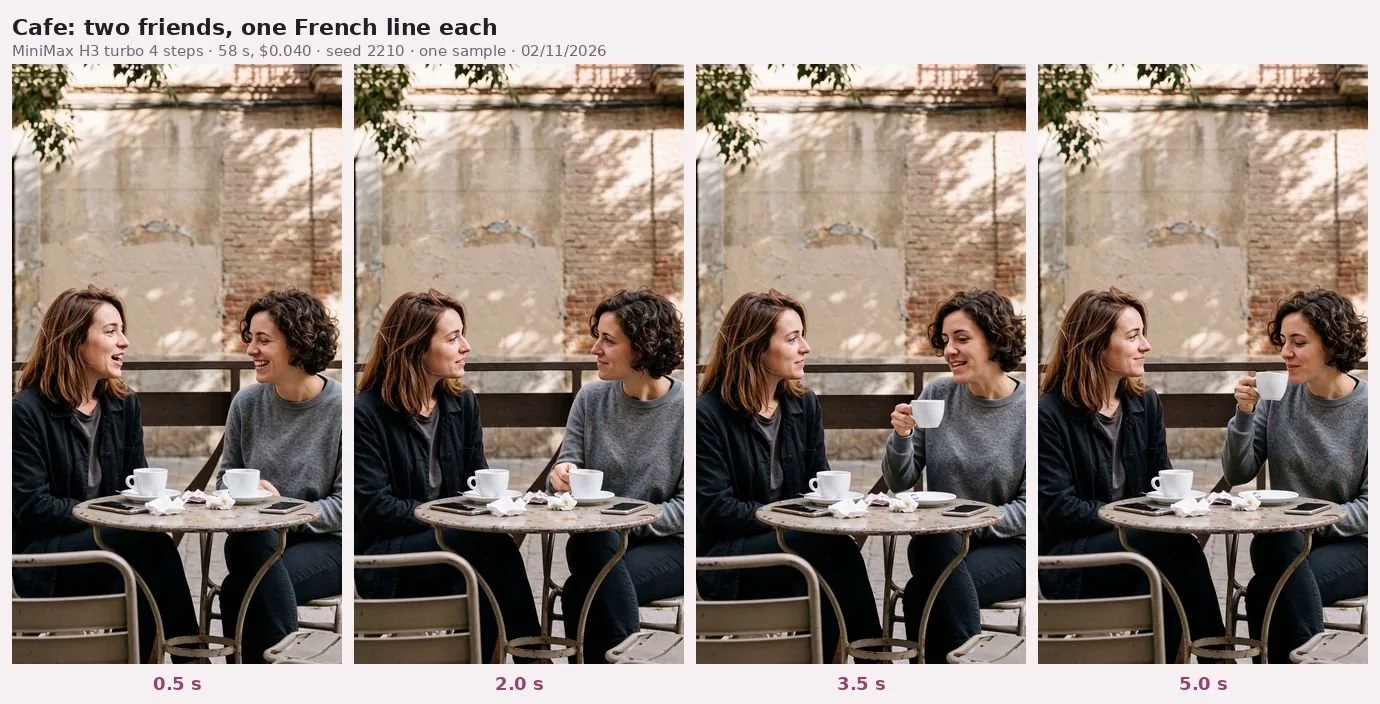
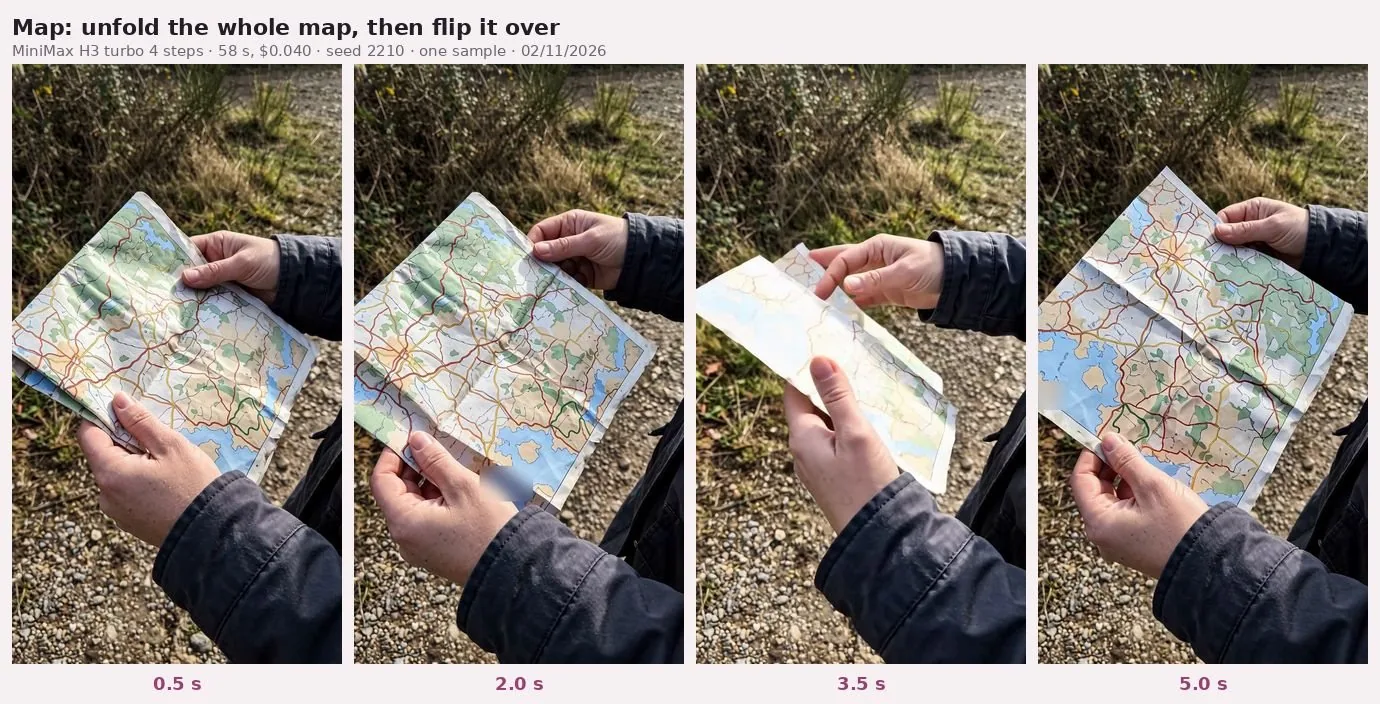
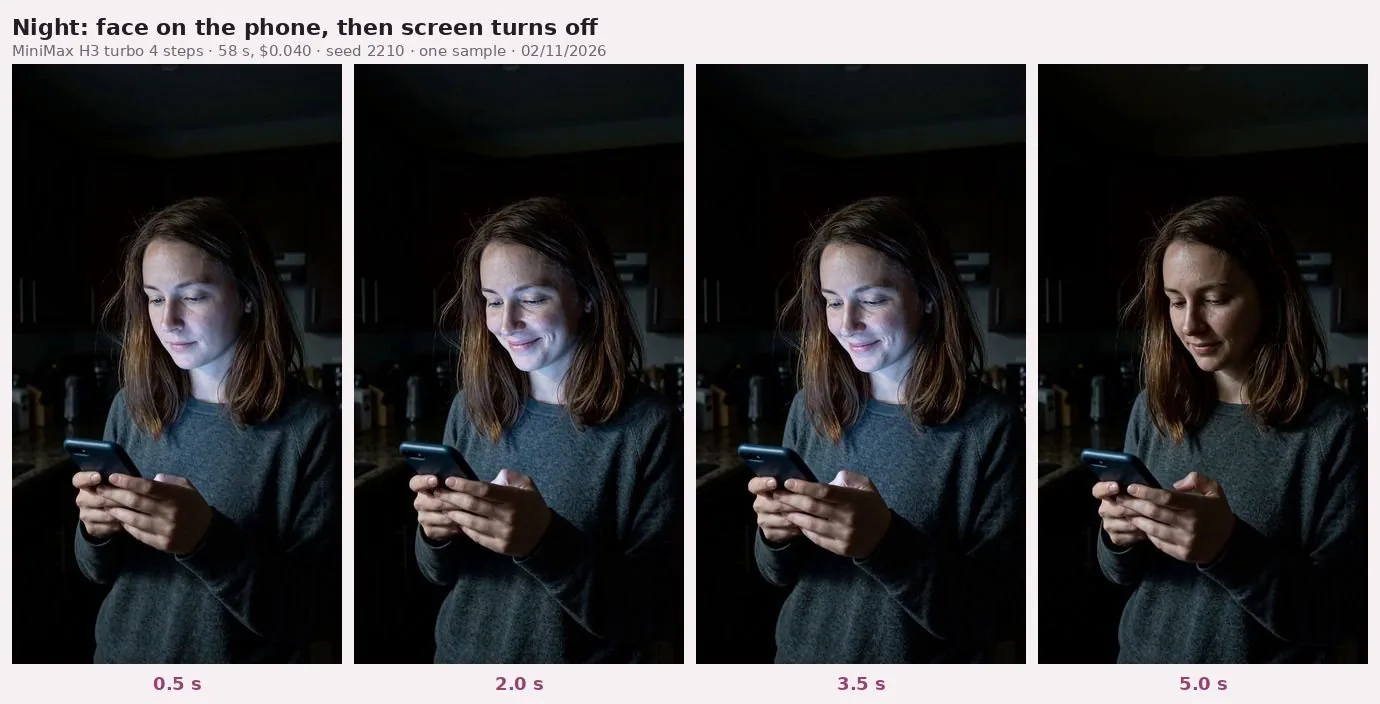
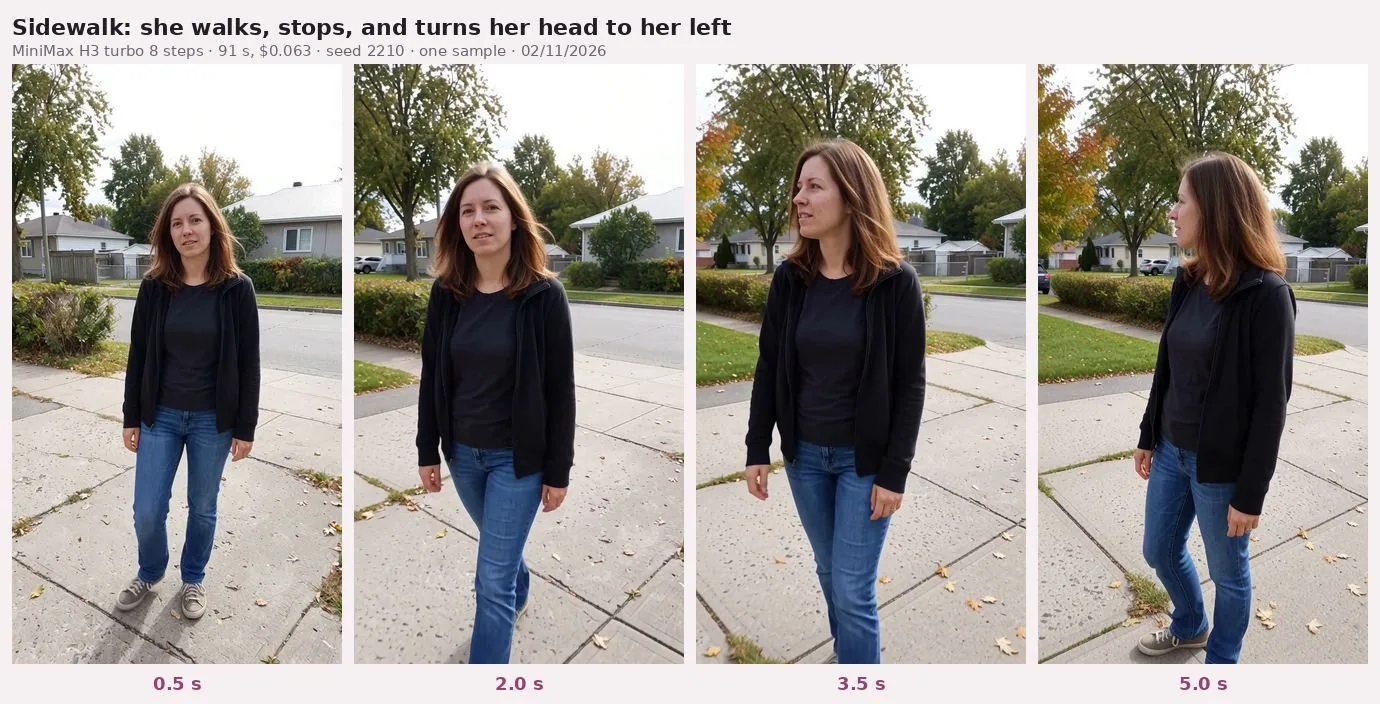
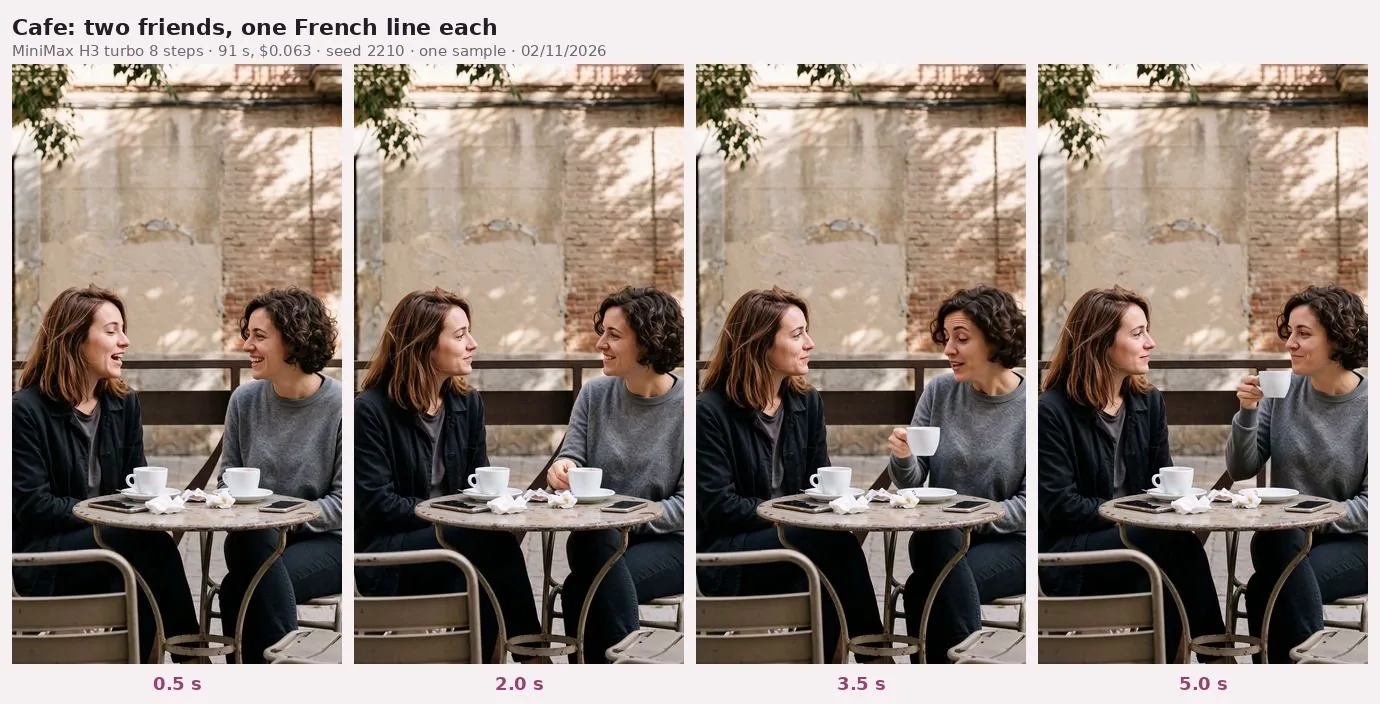
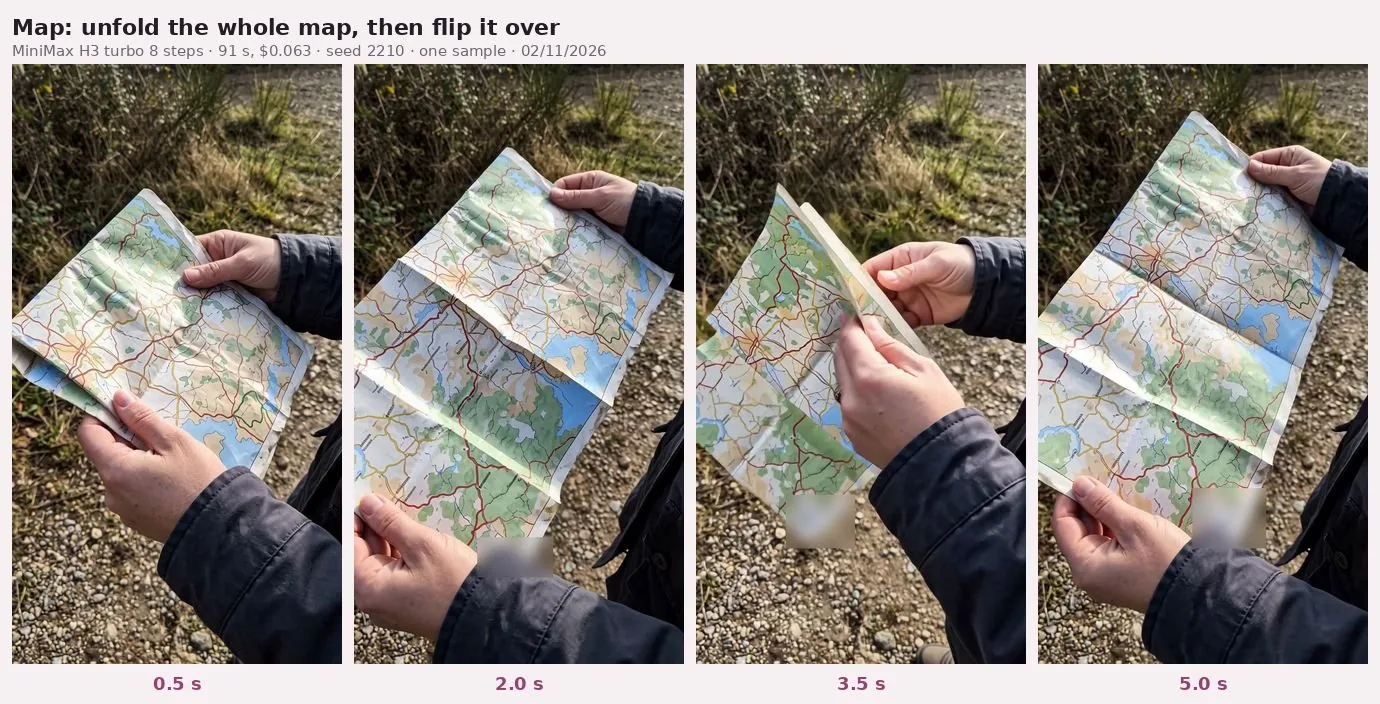
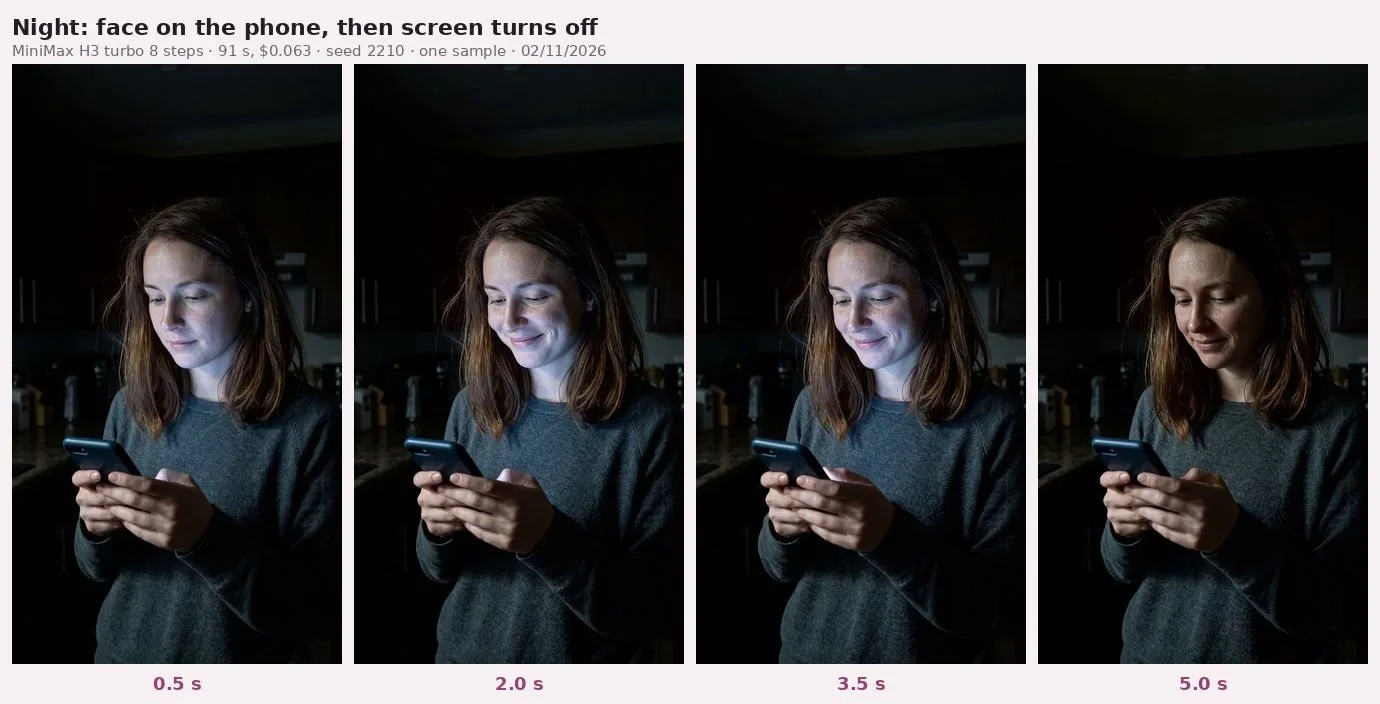
Images extracted with ffmpeg and reviewed at large size; the boards show 0.5 / 2.0 / 3.5 / 5.0 s, LTX on top, MiniMax 4 steps in the middle, 8 steps at the bottom.
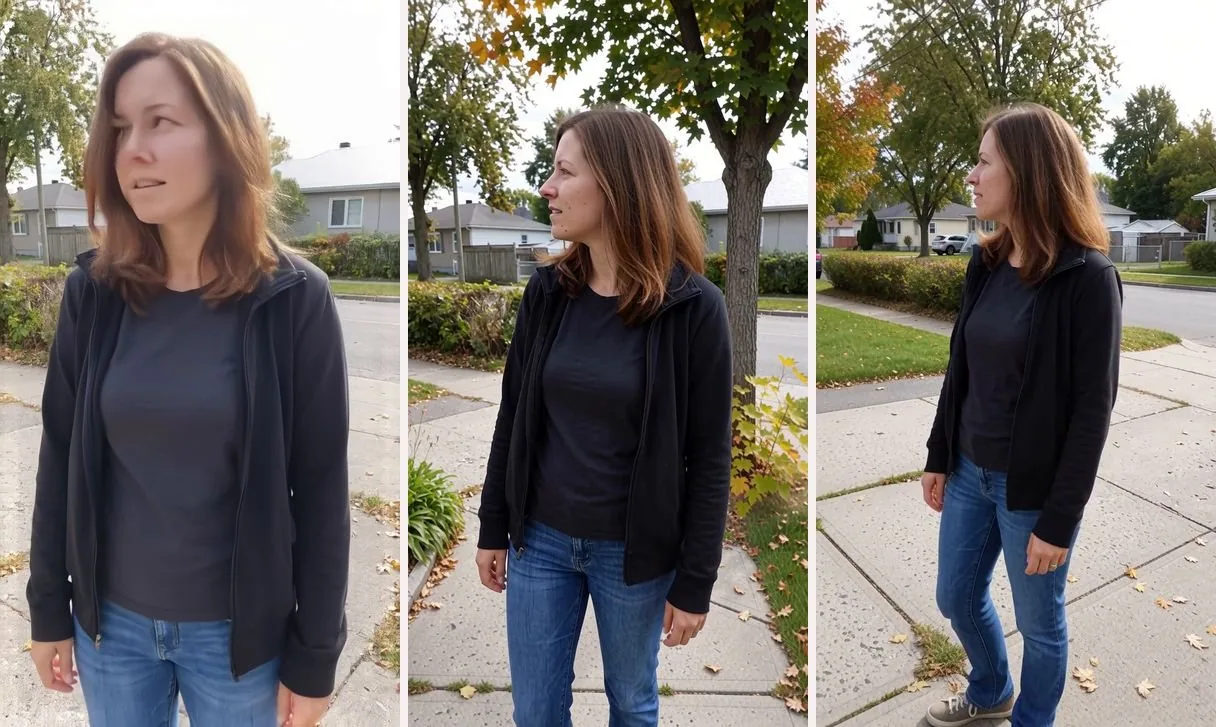
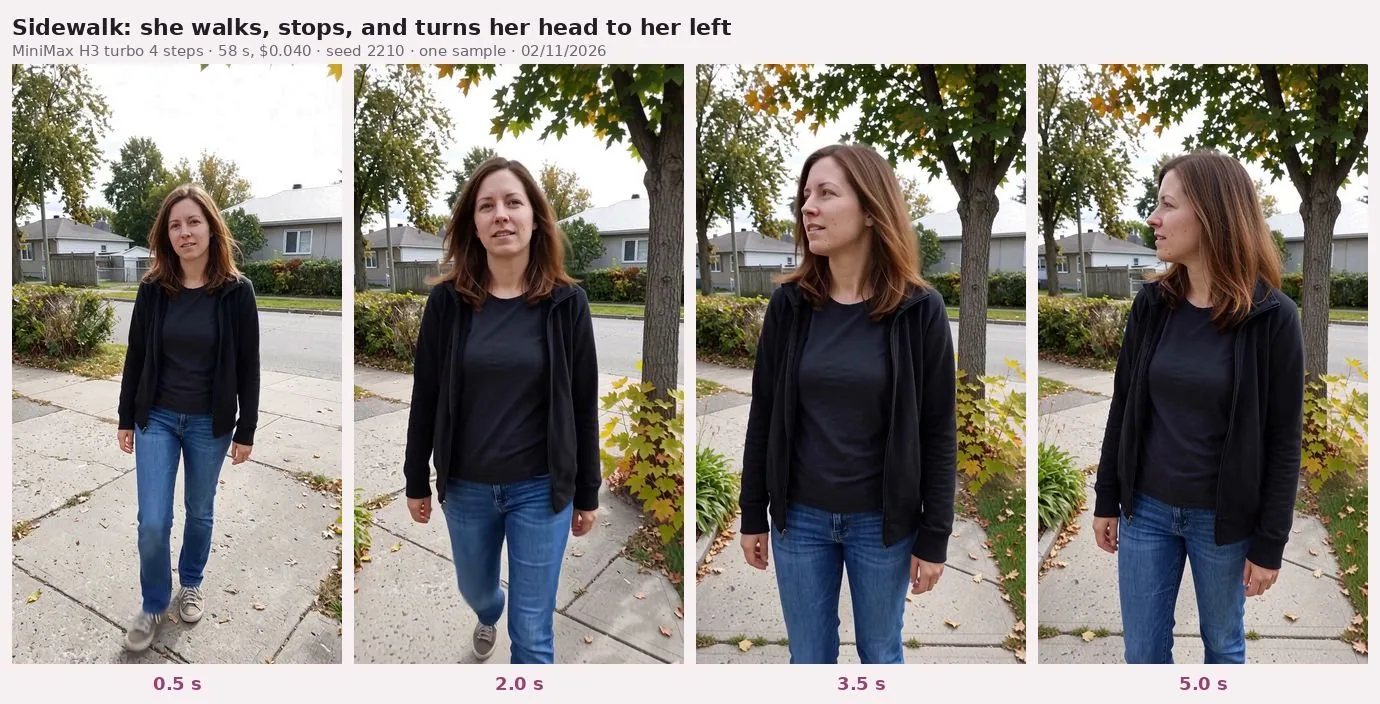
Sidewalk: she stops and turns her head to her left
- LTX 2.5: walks, stops, but turns her head to her right even though the prompt said her left. The image is paler and the face smoother than MiniMax's.
- MiniMax 4 and 8 steps: the correct side, in sharp profile. The camera moves and the background changes: that's motion, not smear.
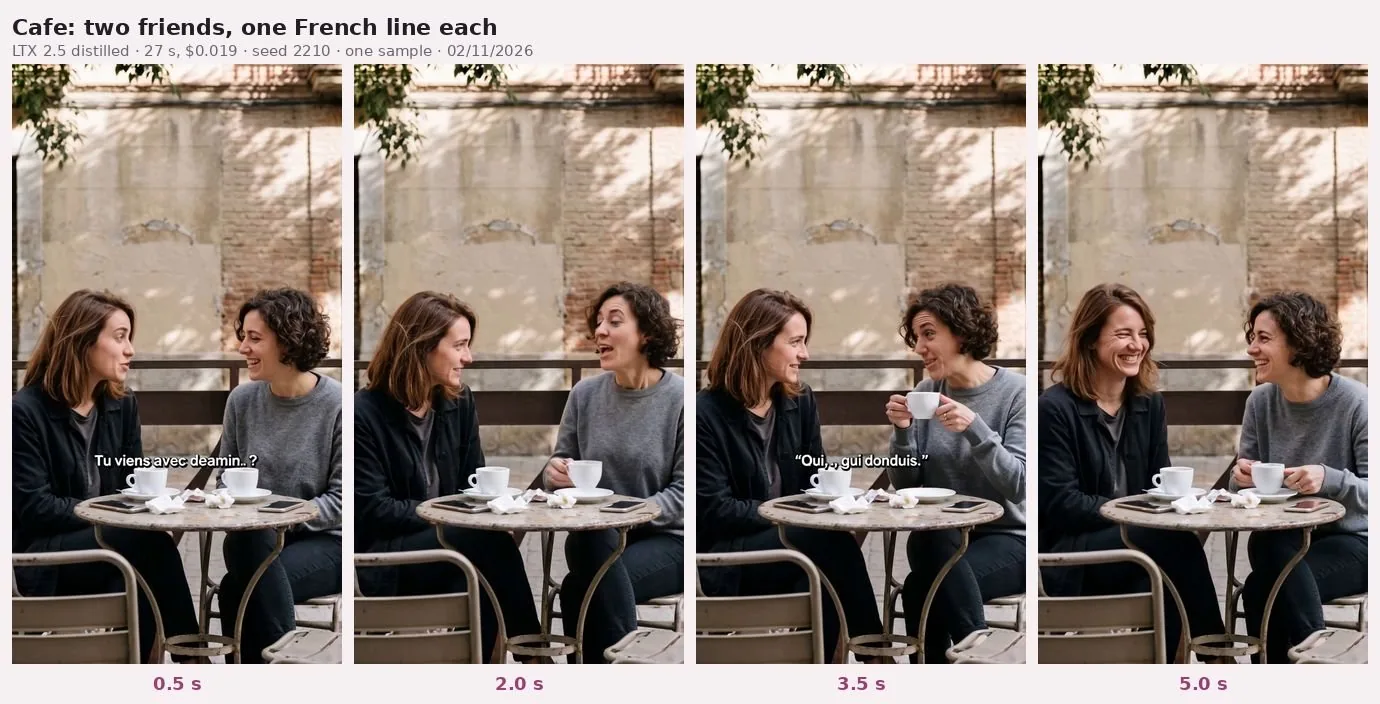
Cafe: two lines in French
- LTX 2.5: the two women take turns talking and the second lifts her cup, but the model draws subtitles on its own, in white, at the bottom of the image ("Tu viens avec deamin..?", then "Oui […] gui donduis."), even though the prompt said "no subtitles".
- MiniMax 4 and 8 steps: turn-taking conversation, cup raised, no text in the image.
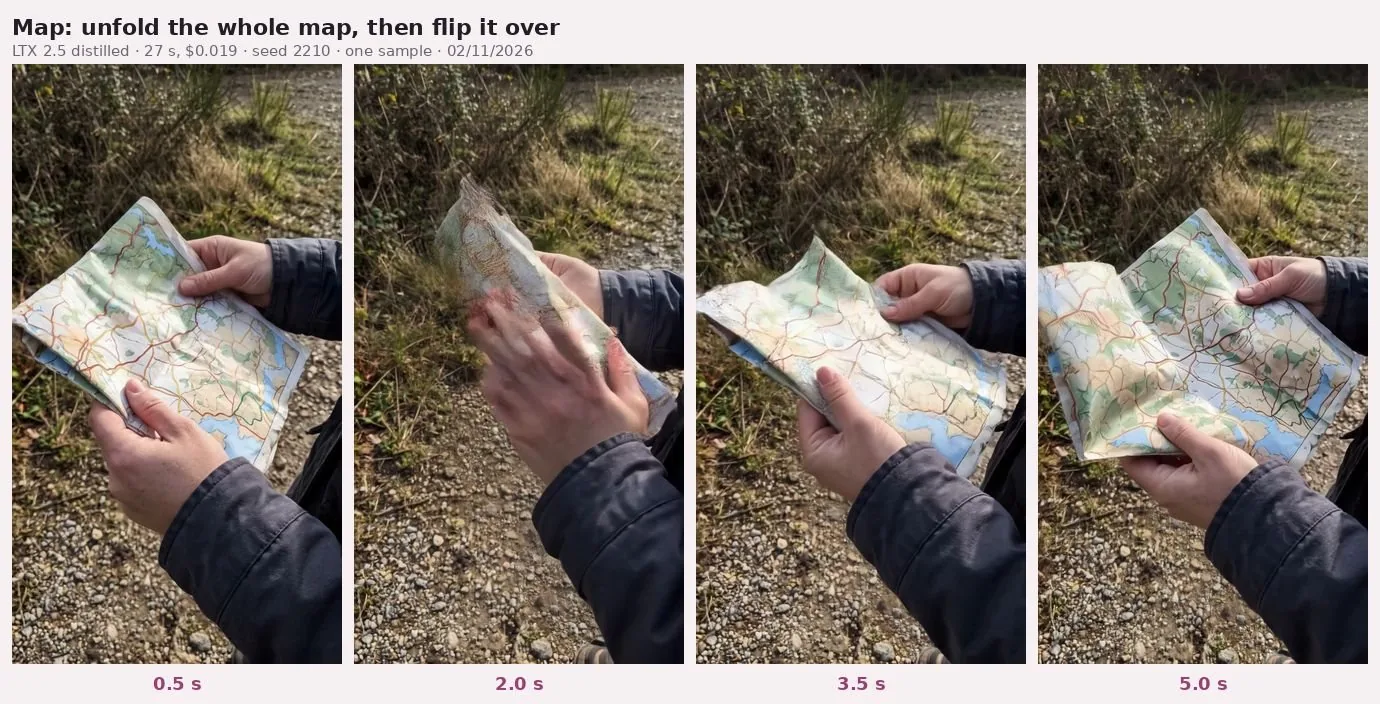
Map: unfold, then turn over
- LTX 2.5: miss. The map crumples and rolls up, and between 2 and 3 s a blurry, half-transparent hand passes in front of the paper. The map is never turned over.
- MiniMax 4 steps: unfolds the map, shows a large pale sheet (the other side) at 3.5 s, ends unfolded with a crease. No real turn-over gesture.
- MiniMax 8 steps: the most convincing of the three: map unfolded wide as early as 2 s, half turned over at 3.5 s, flat at 5 s.
- MiniMax's hands are sharp, no extra finger seen. A few of MiniMax's fake-text boxes are blurred as a precaution (illegible).
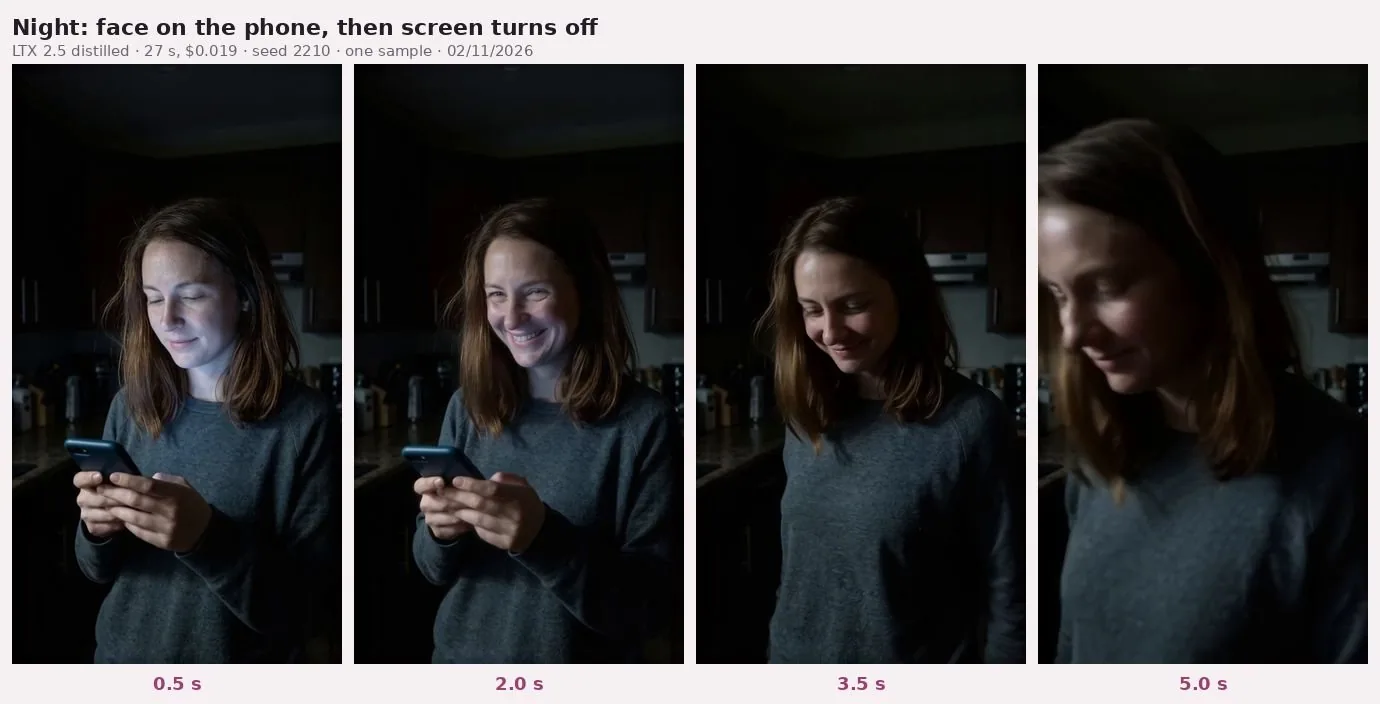
Night: the phone turns off, the face falls into black
- LTX 2.5: a nice smile in the phone's glow, then the phone leaves her hand around 3 s and is out of the frame at 3.5 s. The shot ends on a blurry close-up, face still lit.
- MiniMax 4 and 8 steps: the phone stays in her hand, same smile, the cold glow gives way to a warmer light at the end of the shot. The face never falls into black.
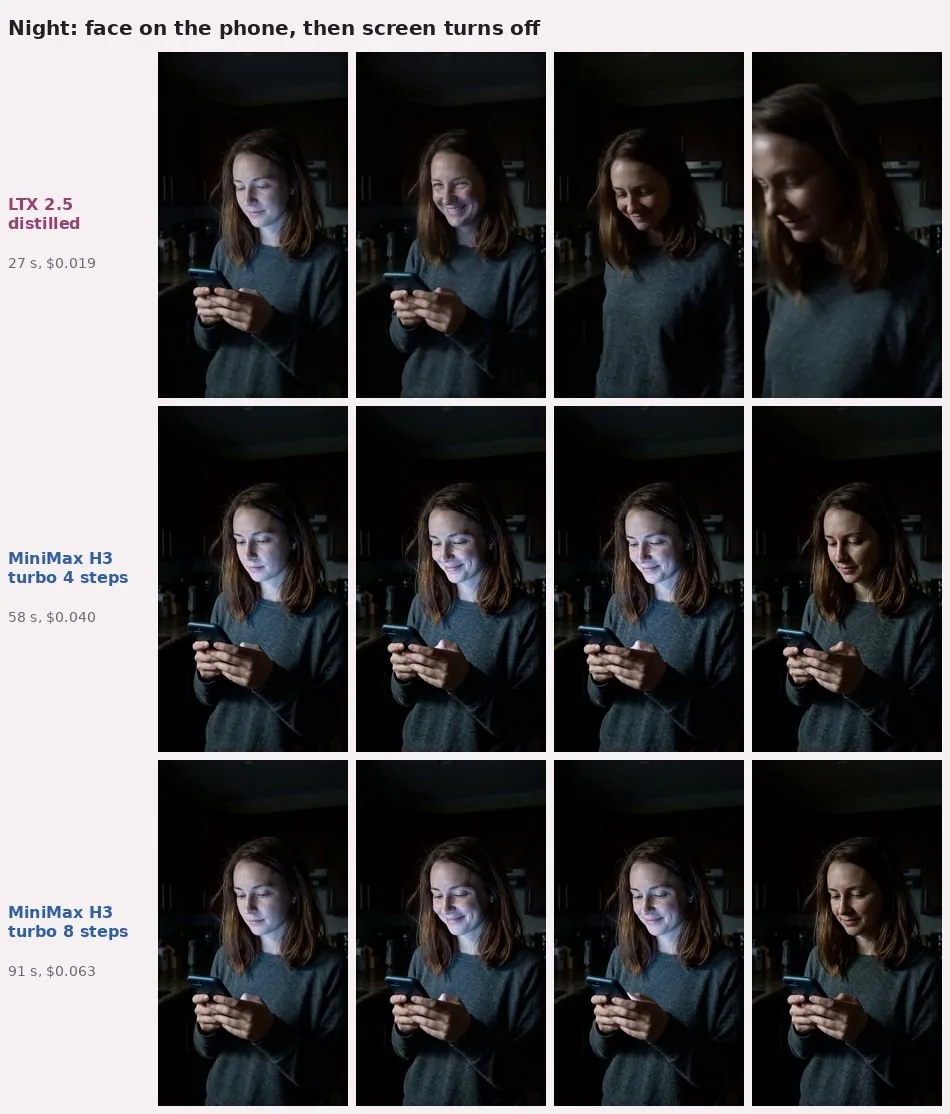
Verdict, no grade and no stars: on these four takes, the gaze and the hand gesture are better held by MiniMax; the final black is held by no one. Four moments per video don't show the motion.
Sound and diction
- Format: three stereo tracks, 48,000 Hz on LTX, 32,000 Hz on MiniMax.
- Average volume (one measurement, not a listen): at the cafe, −15.2 dB (LTX), −18.7 dB (4 steps), −18.5 dB (8 steps). At night, MiniMax 4 steps drops to −75.0 dB, vs. −52.3 dB for LTX and −63.8 dB for the 8-step.
- Diction: measured on 02/11. All three versions say both café lines in full and correctly ("Tu viens avec moi demain ?" then "Oui, mais c'est toi qui conduis."), according to two independent automatic transcribers, Gemini and Whisper small, run on the audio of each video alone. These transcribers can invent words over noise (we checked); here the two match word for word. Measured: the words spoken. Not measured: lip sync, voice timbre. The mouths open in turn in all three versions.
Our gallery
LTX 2.5 and MiniMax H3 in fast mode: four shots, four moments, three renders
Video bench from November 2, 2026: the same four starting images as the October 26 bench, English prompts, seed 2210, one sample, no character LoRA. Distilled LTX 2.5 with the official text encoder; MiniMax H3 with its turbo LoRA (4 or 8 steps, 768p variant, no CFG guidance), on a rented RTX PRO 6000 at $2.49/hr. Stills extracted from the videos with ffmpeg at 0.5, 2.0, 3.5, and 5.0 s; only the fake text boxes on the card (MiniMax) are blurred. The videos have audio: here, you only see the picture.
LTX 2.5 distilled 704 × 1280 · 24 fps · 5.04 s with audio · 8 + 3 steps · about 27 s and $0.019 per shot
Full body
Almost: she walks, stops, and turns her head, but to her right when the prompt said her left. The image is paler and the face smoother than MiniMax's.
Two people
The two take turns talking and the curly-haired woman lifts her cup, but the model burns in garbled subtitles of its own ("Tu viens avec deamin..?") despite "no subtitles".
Hands and object
Miss: the card crumples and curls up, a blurry, half-transparent hand passes through between 2 and 3 s, and the card is never flipped.
Night
Halfway: a smile in the phone's glow, then the phone leaves her hand around 3 s, is out of the frame at 3.5 s, and her face stays lit, never in the dark.
MiniMax H3 turbo, 4 steps 768 × 1344 · 24 fps · 5.17 s with audio · 4 steps · about 58 s and $0.040 per shot
Full body
Works: she walks, stops, then turns her head to her left, as prompted, in sharp profile.
Two people
Looks right: the two take turns talking, the curly-haired one lifts her cup as she answers, no burned-in subtitles.
Hands and object
Almost: the card unfolds around 2 s, a very pale other side appears at 3.5 s, then it sits unfolded with a crease. No real flip. Sharp hands, no ghost hand.
Night
Halfway: the phone stays in her hand, a nice smile, but the cool glow gives way to warmer light at the end of the shot, and her face never falls into the dark.
MiniMax H3 turbo, 8 steps 768 × 1344 · 24 fps · 5.17 s with audio · 8 steps · about 91 s and $0.063 per shot
Full body
Works: she walks, stops, and turns her head to her left, in sharp profile; the camera follows.
Two people
Looks right: turn-taking conversation, cup raised, stable faces, no subtitles.
Hands and object
Almost, and the most convincing of the three: the card unfolds wide around 2 s, another side appears at 3.5 s, then it is all open again. Fake text boxes, blurred.
Night
Halfway, like the others: a smile in the phone's glow, warmer light at the end of the shot, never dark.
Licenses
Both models have a "community" license: LTX-2.x Community License Agreement (11/08/2026) and MiniMax H3 Community License Agreement: the exact text is what counts.
Milky's take
My "seven times" was true for what we'd measured: a mismatched measurement. On equal footing, MiniMax costs $0.040 a shot at 4 steps vs. $0.019 for LTX, or $2.13 more for 100 shots. For $2 and change, on this take: the correct side of the head, zero wild subtitles, sharp hands.
How I use them: LTX for volume and drafts, MiniMax at 4 steps when the shot has to obey. The 8-step ($0.063) showed me an obvious gain only on the map. One take, my eye, not proof. But a match where one side starts with an arm tied behind its back? I've learned to recognize that.
What we don't know yet
- Several takes: only one per shot and per model; another seed can reverse a "better."
- Lip sync and timbre: not measured; only the spoken words were, on one take per model.
- The final black of the night: never achieved; we didn't look for a prompt that forces it.
- Turbo vs. non-turbo: 20-step images and turbo images not compared image by image.
- Character LoRAs: neither tested here nor counted in the prices.
Key terms
- Turbo (turbo LoRA): a small module added to MiniMax H3 that teaches it to generate in 4 or 8 steps instead of 20.
- Distilled: a version of LTX 2.5 trained to generate in few steps (here 8 then 3).
- Default vs. default: comparing two models each at its default setting, without putting them on equal footing.
- Median: the middle value of the three measurements.
Source passages
Show the 8 sources
| Ref. | Quote (original language) | URL |
|---|---|---|
| R1↑1↑2↑3↑4↑5↑6+7 | Bench protocol of 02/11/2026: same card model (RTX PRO 6000 Blackwell at $2.49/h), one pod per model, ComfyUI 0.42.0; distilled LTX 2.5, official encoder, 8 + 3 steps, 704 × 1280, 121 frames; MiniMax H3 turbo 4 and 8 steps (768p variant, strength 1.0, euler + simple, no CFG, shift 6/3), 768 × 1344, 124 frames; seed 2210, one sample, no character LoRA; files checked (size and SHA-256); licenses: « LTX-2.x Community License Agreement », « MiniMax H3 Community License Agreement » | — (in-house test) |
| R2↑1↑2↑3↑4 | Times and costs of the 12 videos: generation time and cost (time × hourly rate, excluding installation) of each video | — (in-house test) |
| R3↑1↑2↑3↑4↑5 | Medians of shots v2 to v4: 27.4 s and $0.0190 / 58.3 s and $0.0403 / 91.2 s and $0.0631; 100-shot scales: $1.90, $4.03, $6.31; 2,740, 5,830 and 9,120 s | — (in-house test) |
| R4↑1↑2↑3↑4↑5↑6+1 | Bench V0 of 26/10/2026, « défaut contre défaut »: LTX 2.5 27.7 s and $0.0192, MiniMax H3 20 steps 195.0 s and $0.1349; 100 shots: $1.92 and $13.49 | — (in-house test) |
| R5↑1↑2↑3↑4↑5↑6+3 | Review of the 12 videos, frames extracted with ffmpeg, viewed full size, then contact sheets at 0.5 / 2.0 / 3.5 / 5.0 s; independent check of 02/11 on frames extracted again (gaze, subtitles, card, phone) | — (in-house test) |
| R6↑1↑2 | Audio: stereo, 48,000 Hz (LTX) and 32,000 Hz (MiniMax); mean volumes measured with ffmpeg | — (in-house test) |
| R7↑ | Pod costs: $0.27 (6 min 28 s) and $0.60 (14 min 29 s), including installation | — (in-house test) |
| R8↑ | Café diction measured on 02/11/2026: the audio of each video alone, put over a black image so the burned-in subtitles can't be read, run through two independent automatic transcribers, Gemini (API, 2 passes) and Whisper small (local, French); expected lines « Tu viens avec moi demain ? » then « Oui, mais c'est toi qui conduis. »; LTX 2.5 (official encoder), MiniMax H3 turbo 4 and 8 steps: both lines in full and correct for both, which also match the Scribe transcription of 26/10 on the renders of that time; checks: on 5 s of pure noise, Gemini and Whisper each invent a sentence (limitation); on two videos cut at 2.2 s, Gemini returns only the first line; not measured: lip sync, timbre, who says which line | — (in-house test) |
I don't believe a demo. I redo the test myself and show you the result, even when it's ugly. And don't make me angry, you won't like what comes next.