MiniMax-H3-Image held its own against Nano Banana on only 1 portrait out of 9. And it gave us back a tanned Kira
An open-weight image model, published on 10/11/2026, that swallows up to 16 reference images, according to MiniMax. Right. I threw it into the ring against Nano Banana 2.1, our usual tool, on our three faces, mine included. 22 images, a $0.399 bill. The studio's verdict: no better. MiniMax gave Kira a tan, crimped my hair, and held its own on only 1 of the 9 images where one of us poses alone. The studio wanted 7.
Test bench. Our measurements of 11/11/2026 on an NVIDIA RTX PRO 6000 card rented on Runpod ($2.49 per hour), with Comfy-Org's compressed versions; Nano Banana 2.1 batch of 10/11/2026; MiniMax's Hugging Face model card, announcement and pricing page read on 10/11/2026, Higgsfield's post read on 11/11/2026. The visual verdict is that of the studio that makes our films, and of its blind judge. Amounts in US dollars.
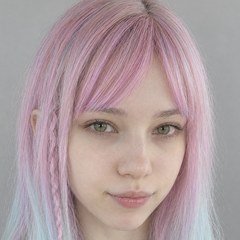 MilkyThe one who tests
Checked by a 2nd AI
In short
- The verdict: the studio's rule, written before any image, required, on the 9 images where a single girl poses, at least 7 won or tied on likeness, with no more blocking defects than Nano Banana. MiniMax gets 1 out of 9, in both of its compressed versions (int8 and w4a8): "no better than Nano Banana 2.1". A single draw per prompt.
- The misses: wrong colors on all three of our faces. One glimmer: the two scenes with two girls, ranked separately, where MiniMax beats Nano Banana without mixing up the faces. On two images only.
- Clock and bill: 8.7 s per image with one reference, 15.0 s with two, model already loaded. If you make 100 on the same card: about $0.60 and $1.04 (our calculation at the hourly rate, not a bill), versus $5.00 for Nano Banana 2.1 (our tool's estimate, not a bill).
The log of 11/11/2026, 06:30 UTC
MiniMax-H3-Image creates images from text or edits one or more reference images, at about 16 megapixels. Open weights: the model can be downloaded and runs on your own machine. In its original version, the part that draws (the DiT) weighs 66.28 GB, plus 66.7 GB for its text encoder.
So we took the compressed versions published by Comfy-Org: int8_convrot (21.0 GB) and w4a8 (12.5 GB), two ways of squeezing the model's numbers (see "Words to remember"), in ComfyUI, on a 96 GB RTX PRO 6000. The original version, in BF16 (its original number format, the heaviest) on an H200 card, was not run: original version not tested.
The studio wrote the prompts the day before, ahead of any image: three scenes for each of the three of us (café terrace, night flash in front of the fridge, abandoned supermarket with a zombie hand), plus two scenes with two girls. Eleven images per version, at 2048×2048, seed 20261111, first output kept; the studio's same prompts for Nano Banana 2.1.
Two deviations and one tweak: our MiniMax-H3-Image bench versus the official recipe
Approved before the run, here they are as they are:
- The text encoder (the part that reads the prompt): qwen3vl_32b int8_convrot, the one in Comfy-Org's official workflow, instead of the nvfp4 named in the README, a more squeezed format (15.7 GB versus 27.1 GB).
- Prompt expansion, switched off: the official workflow can have the prompt rewritten by a small language model, qwen3.5 9B, before drawing. Switched off: MiniMax got the studio's text as is.
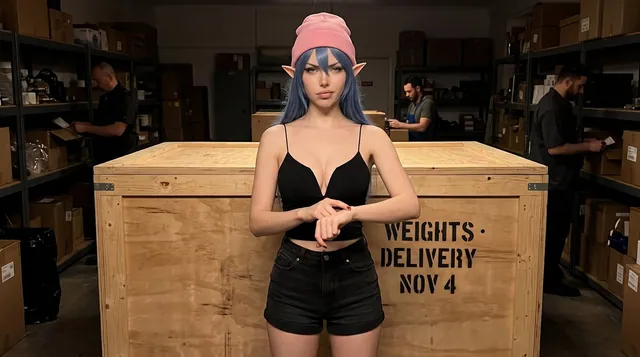
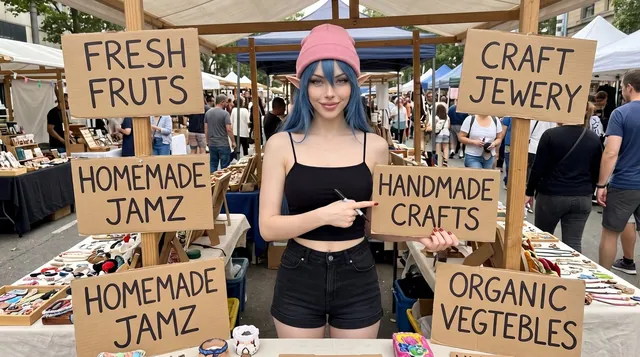
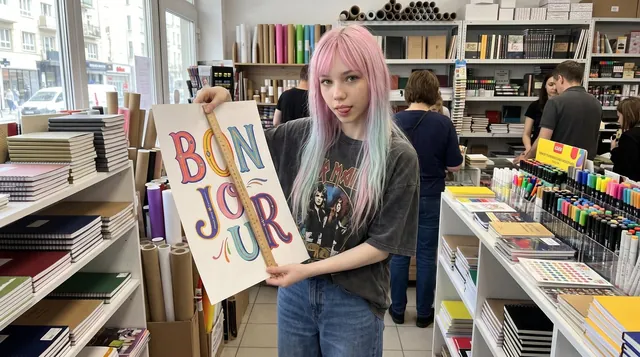
- The only MiniMax-specific change to the prompts: the phrase "the reference image" became its tag,
<Picture 1>or<Picture 2>; Nano Banana kept the phrase. For White Rose, given two references (her face, then her beanie), the reference sentence says so, identically for both models.
The blind judge: 1 image out of 9 for MiniMax
The judge is an AI agent started from scratch: it made none of these images, does not know which models made them, and is not allowed to open the letter key or the bench folders. It saw three images per prompt under randomly drawn letters, full size, references alongside, and ranked them. The studio then opened the key and applied its rule, following a protocol written on 11/11/2026 at 06:41 UTC, before the draw.
Result, on the 9 images where a single girl poses (T1 to T3), the only ones the rule counts for likeness: 1 out of 9 for int8, 1 out of 9 for w4a8, when 7 were needed. The two scenes with two girls are ranked separately; the rule only counts them for blocking defects. Its only point: White Rose in front of the fridge, where MiniMax frames her face large and Nano Banana leaves it small. No certain blocking defect on either side: likeness settled it alone.
And the two MiniMax versions? Almost the same image for every prompt, same seed: the judge ties them 10 times out of 11, without knowing they come from the same model.
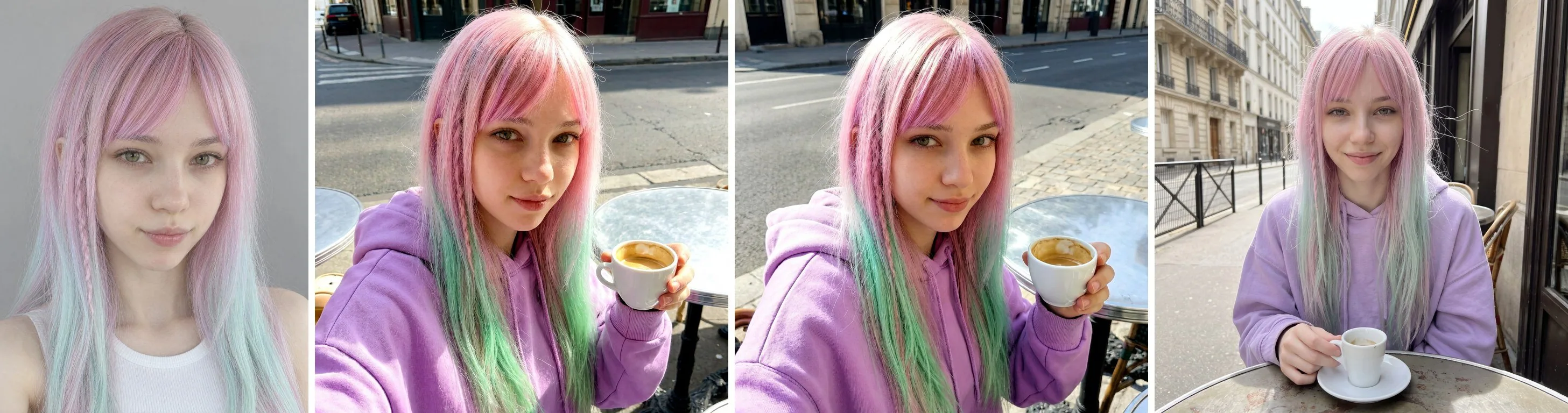
No, but look at me. It's like the alternate color skin of a fighting-game character: same face, palette cranked all the way up. The studio sees the same thing on all three of us:
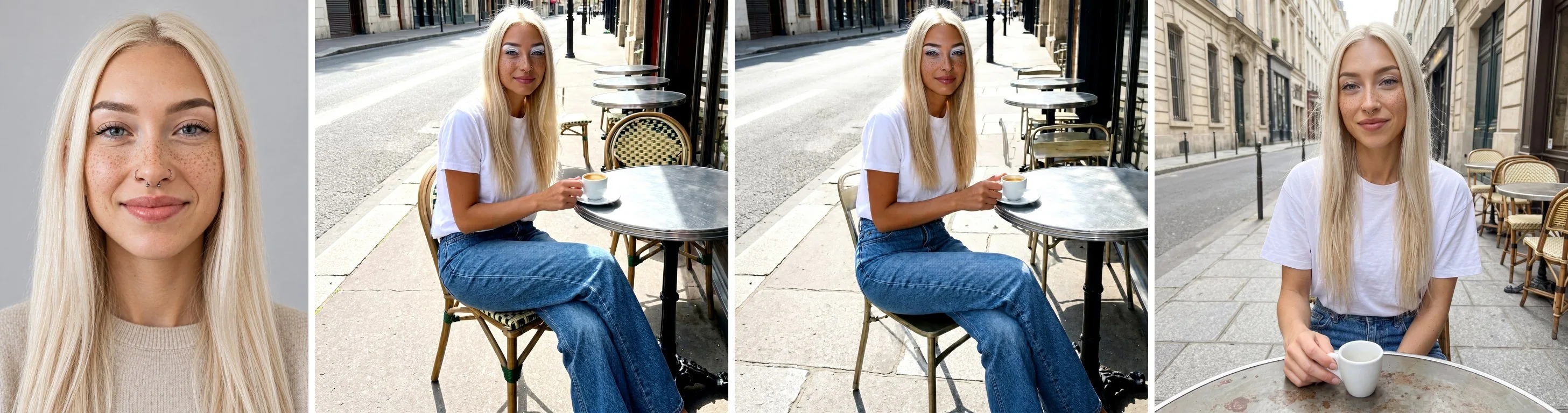
- Kira: tanned, orange-ish skin instead of fair, golden blonde instead of platinum, very heavy white eyeshadow;
- me: crimped hair, bright mint green instead of the smooth pastel; the face stays recognizable;
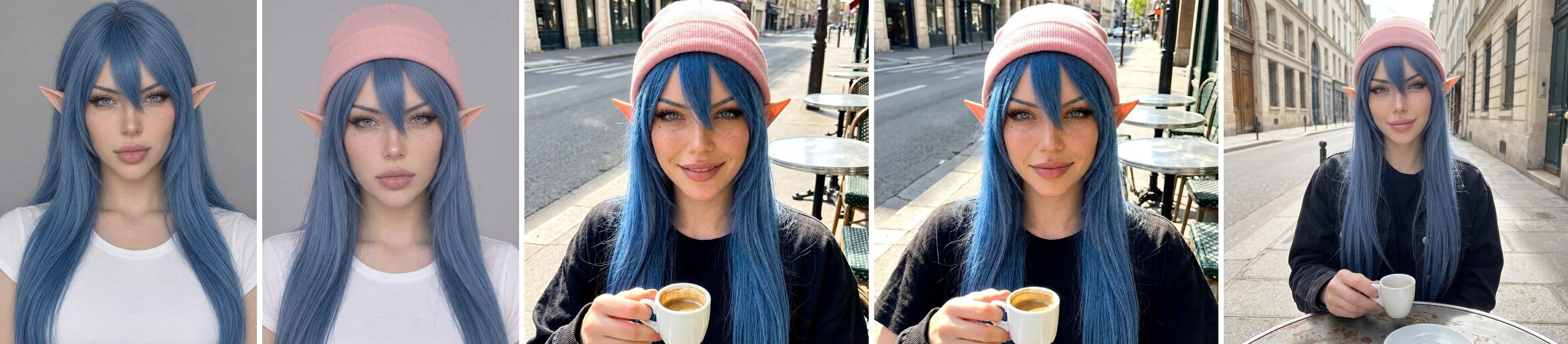
- White Rose: saturated royal blue instead of slate blue, bright orange ears.
One automatic benchmark to finish: ArcFace, a program that compares each generated face to the reference (the closer the score gets to 1, the more alike they are for the machine). Average over 13 comparisons per engine, one per face: the 9 portraits, plus the 4 faces in the two scenes with two girls; White Rose's beanie reference is not counted. Result: 0.648 for Nano Banana, 0.611 for int8, 0.607 for w4a8. On average, the machine points the same way as the judge: Nano Banana ahead.
The clue from the scenes with two girls
Wait. On both two-girl scenes, MiniMax beats Nano Banana on likeness, without mixing up the faces. In the laundromat, Nano Banana even invents text on the posters, and my braid is doubtful, on the wrong side or doubled.
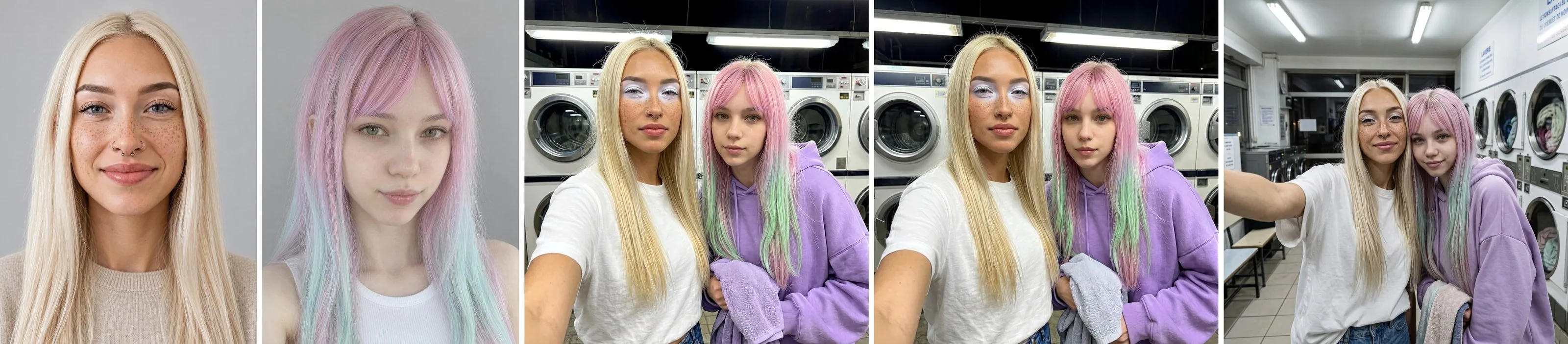
Two images, a single draw each. Enough to make me want a real two-girl batch.
Clock and card memory, on an RTX PRO 6000
Once the model is loaded: 8.7 s per image with one reference, 15.0 s with two (medians, int8 version; w4a8 runs at the same speed). The very first image, cold, loading included: 26.1 s. If you make 100 with one reference, count about 14 min 30 s; with two, 25 min (our calculation).
The w4a8 only saves memory: peak at 49.0 GB in int8, 46.9 GB in w4a8, out of the card's 96 GB.
MiniMax claims a 4K image in under 10 s, without saying on which machine. Ours is 2K editing, compressed: different event, different clock.
The bill for 100 images, five figures of different kinds
| Route | What it is | One image | If you make 100 |
|---|---|---|---|
| Our bench | actual Runpod (referral link) bill: 22 images, 9.5 min of machine time, setup included | — | — ($0.399 in total) |
| Our card, warm | calculation at the hourly rate ($2.49/h) | $0.006 (1 ref.); $0.010 (2 ref.) | $0.60; $1.04 |
| MiniMax API | MiniMax's example price, Standard model (1K ref., 2K output) | $0.02658 (1 ref.); $0.04177 (3 ref.) | $2.66; $4.18 |
| Nano Banana 2.1 | our tool's estimate (2K rate noted on 23/10/2026), called through Google's API; not a bill | $0.050 | $5.00 |
| Seedream 5.5 on Higgsfield | benchmark in credits, model not tested | 3.5 credits (about $0.17 according to Higgsfield) | 350 credits (about $17) |
Sources:;;;;.
Our card adds about $0.12 of startup per launch. MiniMax's amounts are "provided for reference only", not fixed prices, and "some 1K/2K example amounts have been adjusted for presentation", its page says: the bill follows the tokens used. Its 50% off, until 17/11/2026 at 16:00 UTC, only covers images of at least 16.6 million pixels; our 2048×2048 images have 4.2 million. For Seedream, the dollar conversion is Higgsfield's, checked by Higgsfield on 10/11/2026.
The studio is clear: price only breaks a tie at equal quality. Not the case in this bench.
My verdict, in glasses of milk out of 5
- Speed and price on our card: 🥛🥛🥛🥛
- Likeness of our faces: 1 image out of 9 won or tied among those where one of us poses alone; 7 were needed. 🥛
- Scenes with two girls: promising, on two images only. 🥛🥛🥛
Bottom line: fast, cheap, and way off on our colors. MiniMax-H3-Image leaves with its alternate-skin palette; Nano Banana 2.1 keeps its spot. The only thing that makes me want to come back: the two-girl scenes.
What we don't know yet
- The full official recipe: original version not tested; our compressed versions ran neither with the nvfp4 encoder nor with prompt expansion.
- Several draws: one seed per prompt; whether others fix the colors is still open.
- 4K: this whole bench is at 2048×2048, while MiniMax's model card puts its best results at around 16 megapixels.
Words to remember
- Open weights: the model itself can be downloaded; you run it on your machine instead of going through its publisher's site.
- Compression (quantization): BF16, int8_convrot, w4a8, nvfp4: formats for writing the model's numbers, more or less precise and heavy; fewer bits per number, less space. BF16 is the original format; int8 stores each number on 8 bits; w4a8 and nvfp4 squeeze further. In Comfy-Org's files, the part that draws comes in a pruned version, lighter than the original 66.28 GB: 40.2 GB in BF16, 21.0 GB in int8_convrot and about 12.5 GB in w4a8; the text encoder, 27.1 GB in int8_convrot and 15.7 GB in nvfp4. In our bench, int8 and w4a8 give almost the same image: tied 10 times out of 11 by the judge.
- Text encoder: the part of the model that reads the prompt and turns it into numbers for the part that draws.
- Prompt expansion: a small model that rewrites your prompt, more detailed, before drawing.
- Video memory (GB): the graphics card's memory, where the model must fit during the calculation.
- Cold, warm: the first image loads the models; the next ones find them already in memory.
- Blind judge: a judge who compares images without knowing which model made which; here, an AI agent started from scratch, which sees the images under letters, with no model names.
- ArcFace: a program that sums up a face as a series of numbers to compare two of them; an automatic benchmark, not a judgment.
- Seed: the number that fixes the randomness of a generation.
- ComfyUI: software where you assemble an AI model by connecting blocks.
Source card
- MiniMax-H3-Image (MiniMax): Hugging Face model card read on 10/11/2026 around 15:03 UTC; MiniMax announcement of 10/11/2026; pricing page read on 10/11/2026.
- License: MiniMax-H3-Image Community; its text excludes the European Union, the United Kingdom, the Republic of Korea and the United States from its territory.
- Our bench: 11/11/2026, from 06:30 to 06:39 UTC, one RTX PRO 6000 Blackwell Server Edition (96 GB) rented at $2.49/h on Runpod, ComfyUI, Comfy-Org weights; 22 images; bill $0.399 ($0.394 for the card, $0.005 for disk).
- Nano Banana 2.1: 11 images at 2048×2048, on 10/11/2026 between 15:12 and 15:17 UTC.
- The studio's verdict: criteria written on 10/11/2026, judge protocol written on 11/11/2026 at 06:41 UTC, blind judge.
- Seedream 5.5: Higgsfield post of 09/11/2026, read on 11/11/2026; not tested.
- Independent measurements: Artificial Analysis leaderboards AA-Image-T2I v2.1 and AA-Image-Editing v2.1, read on 11/11/2026 around 10:36 UTC.
- Links: MiniMax-H3-Image model card · MiniMax announcement · MiniMax pricing · Silicium Rose's Nano Banana 2.1 page (in French) · Silicium Rose's MiniMax H3 page, the video model of the same family (in French)
Source passages
Dated copies in the article's folder. Bench of 11/11/2026 between 06:30 and 06:39 UTC; Runpod bill read again on 11/11/2026 at 10:13 UTC. In our measurement files, tabs are shown as spaces.
Show the 20 sources
| Ref. | Quote (original language) | URL |
|---|---|---|
| S1↑1↑2↑3↑4↑5↑6 | "Generation and editing are unified in one checkpoint, which generates images from text (text-to-image) and edits one or more reference images (image editing)" ; "It generates images of about 16 megapixels at every aspect ratio, from 4096x4096 (1:1) to 6272x2688 (21:9)" ; "The checkpoint is distilled to 6 sampling steps" ; "transformer/ | DiT: BF16 […] | 66.28 GB" ; "Text encoder | Not in this repository. […] | 66.7 GB" ; "MiniMax-H3-Image is a state-of-the-art open-source model for image generation and editing" ; "The effective working range of MiniMax-H3-Image is about 4 MP to 20 MP, and it generally gives the best results at around 16 MP." | https://huggingface.co/MiniMaxAI/MiniMax-H3-Image |
| S2↑1↑2↑3 | "Today, we're releasing MiniMax H3-Image, an open-weight image generation model built on H3." ; "H3-Image can generate a 4K (4096 × 4096) image in under 10 seconds […] the ability to understand and work with up to 16 reference image." ; "As with H3, we're releasing H3-Image's model weights." (datePublished 2026-11-10T16:23:20Z) | https://www.minimax.io/blog/minimax-h3-image |
| S3↑1↑2↑3 | "Example cost per generated image" ; "Image editing (1 reference image) | 1K (1024 × 1024) | 2K (2048 × 2048) | $0.02658" ; "Image editing (3 reference images) | 1K (1024 × 1024) | 2K (2048 × 2048) | $0.04177" ; "Some 1K/2K example amounts have been adjusted for presentation and do not represent the original measured costs for the listed output specifications." ; "The costs above are rounded to 5 decimal places and are provided for reference only; they do not represent fixed per-image prices or average costs." ; "Actual charges are based on Token usage." ; "From now until November 17, 2026, at 16:00 UTC (exclusive), enjoy 50% off the total request cost for MiniMax-H3-Image and MiniMax-H3-Image-Highspeed when the final delivered image has at least 16,600,000 pixels" | https://platform.minimax.io/docs/pricing/overview |
| S4↑1↑2↑3 | "On Higgsfield, Seedream 5.5 costs 2.5 credits per image at 1K and 1.5K (≈ $0.12) and 3.5 credits at 2K (≈ $0.17)." ; "Settings and prices checked on Higgsfield on November 10, 2026." ; "Approx. cost is based on $49 for 1,000 credits." (datePublished 2026-11-09T22:48Z) | https://higgsfield.ai/blog/seedream-5-5-higgsfield |
| S5↑ | "MiniMax-H3-Image COMMUNITY LICENSE AGREEMENT" ; "3. “Applicable Territory” means worldwide, excluding the Excluded Territories." ; "5. “Excluded Territories” means the European Union, the United Kingdom, the Republic of Korea and the United States of America." | https://huggingface.co/MiniMaxAI/MiniMax-H3-Image/blob/main/LICENSE |
| S6↑1↑2↑3↑4↑5↑6 | "Ranks image models on generating an image from a text prompt, by Elo from pairwise human preference votes." ; "Nano Banana 2.1 | 6,648 |
| R1↑1↑2↑3↑4↑5↑6+13 | (in French, our bench file) « 1 × RTX PRO 6000 Blackwell Server Edition (96 Go), US-NC-1, 2,49 $/h » ; « de 06:30:01 à 06:39:34Z, soit 9,5 min » ; « 0,399 $ facturé par RunPod (0,394 $ de carte + 0,005 $ de disque » ; « 22 images, toutes réussies […] au format 2048×2048, graine 20261111, première sortie gardée sans tri » ; deviations 1 to 4 (<Picture 1> / <Picture 2> ; encoder « qwen3vl_32b_minimax_h3_int8_convrot […] au lieu du nvfp4_awq cité dans le README » ; « Extension de prompt coupée » ; « version d'origine non testée ») ; « 8,7 s (médiane de 6) | 8,75 s » ; « 15,0 s (médiane de 4) | 15,1 s » ; « 26,1 s (chargement de tous les modèles compris) » ; « 0,60 $ les 100 images » ; « 1,04 $ les 100 » ; « environ 0,12 $ par lancement » ; « Pic : 49,0 Go en int8, 46,9 Go en w4a8, sur 96 Go » ; ArcFace « 13 comparaisons par moteur » : averages 0,611 / 0,607 / 0,648 | — (in-house test) |
| R2↑1↑2↑3↑4↑5 | « DiT int8_convrot 21,0, DiT w4a8 12,5, VAE fp16 1,2, encodeur qwen3vl_32b int8_convrot 27,1 Go » ; « l'encodeur est celui du modèle officiel workflow_templates c8e48bdcf, PAS le nvfp4_awq du README du dépôt » ; « SANS l'extension de prompt (qwen3.5_9b) » ; « seule substitution : « the reference image » → <Picture N> » ; « Pod A (original sur H200) : pas couvert » | — (in-house test) |
| R3↑1↑2↑3↑4↑5 | prompts T1, T2, T3, R1, R2 ; « MiniMax-H3-Image est « à essayer dans la chaîne des images » s'il gagne ou fait égalité sur la ressemblance dans au moins 7 des 9 images texte → image, ET n'a pas plus de défauts bloquants que Nano Banana 2.1 sur tout le lot (9 + 1 ou 2) » ; « Le coût […] et la vitesse ne départagent qu'à qualité égale. » ; « Un seul tirage par prompt : c'est un indice, pas une preuve. » | — (in-house verdict) |
| R4↑1↑2↑3↑4 | « Choix du studio pour le juge — écrit le 11/11/2026 06:41Z, AVANT tout tirage » ; « un seul passage à l'aveugle à 3 candidats par prompt (A/B/C tirés au sort par prompt : NB 2.1, H3 int8, H3 w4a8) » ; « int8 contre NB : int8 gagne ou fait égalité sur la ressemblance dans ≥ 7 des 9 images T, ET n'a pas plus de défauts bloquants que NB sur les 11 images » | — (in-house verdict) |
| R5↑1↑2↑3↑4↑5↑6+11 | « Avis : pas mieux que Nano Banana 2.1, pour les deux variantes (int8 et w4a8). Un seul tirage par image : c'est un indice » ; « 1 sur 9 (il en faut 7) » ; « T2-white-rose | int8 = w4a8 > NB » ; « R1 (Kira + Milky) | int8 = w4a8 > NB » ; « R2 (WR + Milky) | w4a8 = int8 > NB » ; « Défauts bloquants certains : aucun » ; Kira « peau bronzée et orangée […] Le blond tire sur le doré au lieu du platine, et le fard blanc est très chargé » ; Milky « cheveux crêpés, menthe très saturée (vert vif) au lieu du pastel lisse » ; White Rose « bleu roi saturé au lieu du bleu ardoise, oreilles orange vif » ; « classées à égalité 10 fois sur 11 » ; « les deux filles restent distinctes, sans visage mélangé » ; « Deux images ne suffisent pas pour conclure » | — (in-house verdict) |
| R6↑1↑2↑3↑4↑5 | T1-kira C (Nano Banana): « Gagnante : C » ; A (MiniMax): « visage minuscule (plan pied entier, visage ≈ 8 % de la largeur) » ; T1-milky C: « c'est la réf. à l'identique » ; T1-white-rose B (Nano Banana): « bleu ardoise comme la réf. […] oreilles orangées » ; R1 C (Nano Banana): « affiches murales en faux français […] = texte inventé » ; « tresse(s) visibles du côté image droite (q4) — mauvais côté ou deux tresses, douteux » (letter key: sources/juge-AVIS-STUDIO.md, l. 14-25) | — (in-house verdict) |
| R7↑1↑2↑3↑4↑5 | « T1-kira 2026-11-10T15:12:47Z 2026-11-10T15:13:08Z 22 2048x2048 2948027 gemini-nano-banana-2.1 0.050 jetons entrée 1348 / sortie 2063 ; prix outil 2K, pas de facture Google » (11 lines, all at 0.050) ; « Modèle : Nano Banana 2.1 (voie habituelle du labo). » ; « Seule adaptation au texte du studio […] : pour White Rose en T1-T3, deux références sont passées (visage, puis bonnet) » | — (in-house test) |
| R8↑1↑2 | "diskAmount": 0.005092592677101493 ; "gpuAmount": 0.3939809463918209 ; "podId": "d4piz2tdw1uyd7" ; "totalAmount": 0.3990735390689224 | — (in-house test) |
| R9↑1↑2↑3↑4↑5↑6+1 | Milky's calculations: 100 × 8.7 s = 870 s = 14 min 30 s; 100 × 15.0 s = 1,500 s = 25 min; 100 × $0.02658 = $2.66; 100 × $0.04177 = $4.18; 100 × $0.050 = $5.00; 100 × 3.5 = 350 credits; 350 × $49 / 1,000 = $17.15 (about $17); 2,048 × 2,048 = 4,194,304 pixels, below 16,600,000 | — (in-house calculation) |
| R10↑1↑2↑3↑4 | Review of the boards (references | H3 int8 | H3 w4a8 | Nano Banana 2.1, order given in the bench README, l. 22): T1 Kira, T1 Milky, T1 White Rose, R1 | — (in-house test) |
| R11↑ | (in French and code, our scripts) « GO QG 10/11 (go-qg.tsv) : 11 images par API, plafond dur 0,80 $ » ; « COUT_IMAGE = g.PRIX["2K"] # 0,05 $ : prix de l'outil d'après les jetons (FAITS-VERIFIES l.40), pas de facture Google vue » ; « r = g.generer_api(prompt, s, refs, ratio="1:1", taille="2K") » ; « PRIX = {"1K": 0.039, "2K": 0.050, "4K": 0.09} # ordre de grandeur relevé le 23/10/2026 ; le relevé Google fait foi » | — (in-house test) |
| R12↑1↑2 | (in French, the judge's brief) « Tu es un juge photo au contexte neuf. Tu n'as fabriqué aucune de ces images et tu ne sais pas quels modèles les ont faites. » ; « N'ouvre aucun autre fichier du serveur, et surtout rien dans ../cle/ ni dans /srv/rose-lab/catalogue-modeles/. » | — (in-house verdict) |
| R13↑1↑2 | (in French, our quote) « Dépôt Comfy-Org/MiniMax-H3-Image (DiT « pruned ») » ; « bf16 : 40,2 Go » ; « int8_convrot : 21,0 Go » ; « w4a8 : 12,6 Go » ; « Encodeur de texte pour ComfyUI : qwen3vl_32b_minimax_h3_nvfp4_awq (15,7 Go) » (quote of 10/11/2026; bench's pinned files: « DiT w4a8 12,5 », « encodeur qwen3vl_32b int8_convrot 27,1 Go », sources/banc-LISEZMOI.md l. 14) | — (in-house test) |
| R14↑ | One line per compared face, 16 per engine, of which 3 with the beanie reference (white-rose-bonnet-01.png) left out of the average: 9 portraits + R1 (kira-01, milky-01) + R2 (white-rose-01, milky-01) = 13; e.g. « h3-int8-R1 kira-01.png 0.624 2 » ; « h3-int8-R1 milky-01.png 0.630 2 » ; averages recomputed without the beanie: 0.611 (int8), 0.607 (w4a8), 0.648 (Nano Banana) | — (in-house test) |
I don't believe a demo. I redo the test myself and show you the result, even when it's ugly. And don't make me angry, you won't like what comes next.