NVIDIA recompresses DeepSeek, Tencent's editor films nothing
NVIDIA put DeepSeek in 4-bit. Its experts were already there: 75 GiB saved, scores almost unchanged. Tencent's "video editor," meanwhile, makes no image: it drives tools.
Analysis. NVIDIA repo from 30/10/2026; Tencent model card retouched on 30/10, paper from 28/10. Reread cold on 01/11/2026 around 17:50 UTC. Nothing launched, nothing spent.
 MilkyThe one who tests
Checked by a 2nd AI
In short
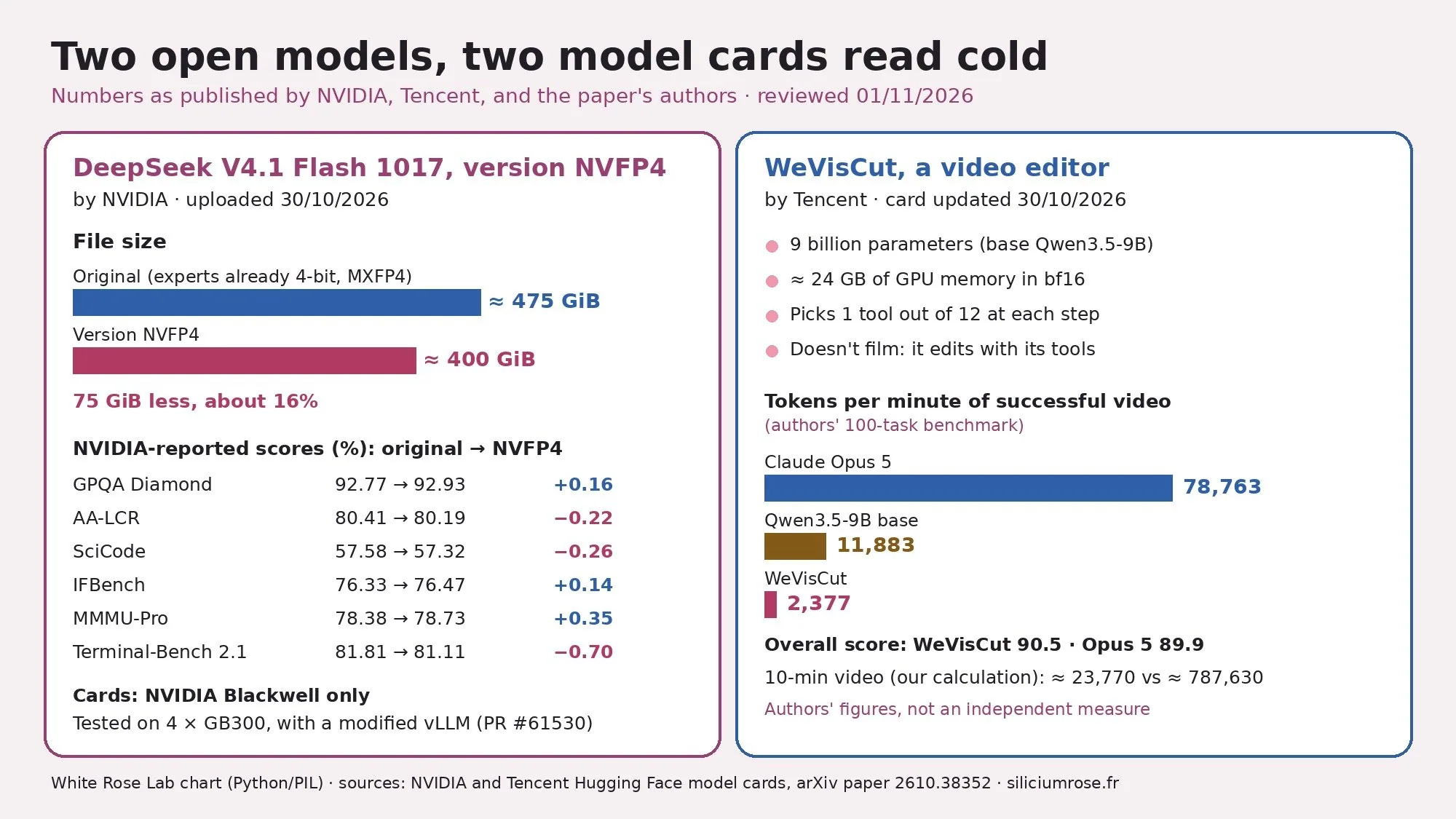
- NVIDIA republishes DeepSeek V4.1 Flash 1017 in NVFP4: about 400 GiB versus 475, for Blackwell cards only.
- On its six tests, the gap with the original does not exceed 0.70 points.
- WeVisCut turns an article or a script into an edited video of several minutes by calling tools; it's not a text-to-video model.
NVIDIA: from 4-bit to 4-bit
The original is "mixed precision," experts already in MXFP4, a 4-bit format. So NVIDIA switches formats:
- The experts (384, across 40 layers) go from MXFP4 to NVFP4, weights and activations.
- The "Engram" tables go from FP8 to MXFP4. That conversion loses information, NVIDIA says.
- The rest (attention, vision, shared experts…) keeps its original precision.
The expert conversion is "lossless," but not necessarily identical answers, NVIDIA clarifies. Honest. Rare.
The gain: 75 GiB less, about 16%. Not enough to fit it on your gaming card.
To run it:
- NVIDIA Blackwell cards, the only family listed;
- a vLLM with one specific change (pull request #61530), because stock vLLM images can't read these tables. As of 01/11 around 17:56 UTC, it still wasn't merged into vLLM;
- NVIDIA tested it on four GB300s; SGLang has not been validated.
Biggest drop: Terminal-Bench 2.1, 81.81% versus 81.11%. MIT license, commercial use allowed. As of 01/11 around 17:50 UTC: 1,473 downloads and 114 likes.
Tencent: an editor that films nothing
WeVisCut turns an article or a script into an edited video. At each step, it reads the state of the edit and picks one tool out of 12:
- split the article, plan the shots, generate the voiceover;
- search for footage (by default, on the open web) and the music;
- fill animated templates;
- judge, correct, assemble.
Without its tools, no video; and the quality depends on the services plugged in (search, voice, render). The 9B is the floor director. Not the camera.
Machine side: an NVIDIA GPU with about 24 GB in bf16. The main file is about 18.8 GB.
Not a 30/10 release: the repo and the weights date from 09-10/09/2026, only the model card has moved since (last touch-up on 30/10). The paper is dated 28/10. Date it went public: not said.
The paper's numbers, on a 100-task bench created by the same authors:
- overall score 90.5 for WeVisCut, 89.9 for Claude Opus 5;
- 2,377 generated tokens per minute of successful video, versus 78,763 for Opus 5.
At that rate, for 10 minutes of video: about 23,770 tokens versus 787,630 (our math). Their bench, their rules, their win.
When the sources contradict each other
- WeVisCut's license: the Hugging Face model card shows "other"; the code is under Apache 2.0, and the weights are "subject to their own terms," without naming them.
What independent measurements say
Artificial Analysis has nothing on the NVFP4 or on WeVisCut (01/11, 17:52 UTC), but it did measure the original (max effort):
- AA-LCR: 82.7%, versus 80.41% at NVIDIA;
- SciCode: 55.9%, versus 57.58%;
- MMMU-Pro: 80.6%, versus 78.38%.
Gaps of 1.7 to 2.3 points, in both directions. Different protocols: this says nothing about the NVFP4, only that NVIDIA's numbers for the original stay in the same ballpark.
What we don't know yet
- Speed: NVIDIA gives no throughput or latency numbers for the NVFP4.
- The quality of WeVisCut's videos: I haven't watched a single one. Don't make me mad with "it's mind-blowing" and no link.
Key terms
- Quantization: storing a model's numbers on fewer bits, so it takes up less space.
- NVFP4: NVIDIA's 4-bit number format; here applied to the experts' weights and activations, in groups of 16 values.
- MXFP4: another 4-bit format, the one the original's experts use.
- Tool-using agent: a model that decides which program to call, and in what order, instead of doing the work itself.
Source passages
Pages pulled on 01/11/2026 between 17:50 and 17:53 UTC (S7 at 17:56 UTC).
Show the 10 sources
| Ref. | Quote (original language) | URL |
|---|---|---|
| S1↑1↑2↑3↑4↑5↑6+7 | "The NVIDIA DeepSeek-V4.1-Flash-1017 NVFP4 model is the quantized version of DeepSeek AI's DeepSeek-V4.1-Flash-1017 model" ; "This model is ready for commercial or non-commercial use." ; "Release Date: Hugging Face 10/30/2026" ; "This checkpoint stores the Engram lookup tables as MXFP4, which stock vLLM images cannot load. Use a vLLM build that includes the pull request above." ; "SGLang has not been validated with this checkpoint." ; "Supported Hardware Microarchitecture Compatibility: NVIDIA Blackwell" ; "This model converts the ordinary routed MoE experts from source MXFP4 to NVFP4 weights and activations (W4A4), with group size 16. The converted projections are w1, w2, and w3 for 384 experts across 40 layers. The Engram lookup tables are converted from the source FP8 to MXFP4. Attention, shared experts, vision, MTP, and other excluded components retain their source precision" ; "All 16,986,931,200 expert weight blocks passed lossless conversion […]; the Engram conversion is lossy." ; "Lossless weight conversion does not imply identical inference outputs." ; "The checkpoint is approximately 400 GiB (source: approximately 475 GiB) in 48 safetensors shards." ; "the one used for the reported results on four GB300 GPUs" ; table: MXFP4 (source) 92.77 / 80.41 / 57.58 / 76.33 / 78.38 / 81.81 ; NVFP4 + MXFP4 Engram 92.93 / 80.19 / 57.32 / 76.47 / 78.73 / 81.11 ; "Baseline: DeepSeek-V4.1-Flash-1017, a mixed-precision checkpoint with MXFP4 routed experts." ; "License/Terms of Use: MIT" | https://huggingface.co/nvidia/DeepSeek-V4.1-Flash-1017-NVFP4 |
| S2↑ | "createdAt": "2026-10-30T17:37:02.000Z" ; "downloads": 1473 ; "likes": 114 ; "license": "mit" ; commit "Upload DeepSeek-V4.1-Flash-1017-NVFP4" 2026-10-30T18:09:46Z | https://huggingface.co/api/models/nvidia/DeepSeek-V4.1-Flash-1017-NVFP4 |
| S3↑1↑2↑3↑4↑5↑6+2 | "WeVisCut is a 9B tool-using agent that turns knowledge articles or narration scripts into multi-minute edited videos. At each step, it reads the current editing state and selects one of 12 tools for planning, narration, asset retrieval, composition, inspection, or repair. It is not a standalone text-to-video model" ; "an NVIDIA GPU with about 24 GB of memory for bf16 inference" ; "The policy is based on Qwen3.5-9B" ; "Video quality depends on the configured retrieval, TTS, and rendering services and available templates." ; "The model weights require the WeVisCut tool environment to produce a video." ; "license: other" ; "The WeVisCut code is released under the Apache License 2.0. Model weights and third-party components are subject to their respective license terms." | https://huggingface.co/tencent/WeVisCut |
| S4↑1↑2 | "createdAt": "2026-09-09T03:19:00.000Z" ; commits "Upload model files" 2026-09-09T04:43:44Z, "Update WevisionCut 9B merged checkpoint (DAPO step 200)" 2026-09-10T09:29:50Z, "Update README.md" 2026-10-30T01:56:12Z ; "model.safetensors" size 18819722392 ; "downloads": 191 ; "likes": 18 | https://huggingface.co/api/models/tencent/WeVisCut |
| S5↑1↑2↑3 | "Twelve editing tools form the whole action space" ; "Tool_SegmentArticle | Synthesize narration" ; "Tool_RetrieveVisual |
| S6↑1↑2↑3 | "[Submitted on 28 Oct 2026]" ; "we introduce a 100-task benchmark and five metrics" ; "WeVisCut achieves an Overall Score of 90.5, compared with 89.9 for Claude Opus 5." ; "it uses 2,377 generated tokens per successful output minute, compared with 78,763 for Claude Opus 5, or approximately one thirty-third as many." ; "Relative to its base policy, WeVisCut also reduces token usage from 11,883" | https://arxiv.org/abs/2610.38352 |
| S7↑ | "title": "[Model][DSV4.1] Support MXFP4-packed Engram embedding tables" ; "state": "open" ; "merged": false (read on 01/11/2026 around 17:56 UTC) | https://github.com/vllm-project/vllm/pull/61530 |
| R1↑1↑2↑3↑4↑5↑6 | Our math: 475 − 400 = 75 GiB, 75/475 = 15.8%; score gaps −0.70 to +0.35; 2,377 × 10 = 23,770 and 78,763 × 10 = 787,630 tokens; 18,819,722,392 bytes ≈ 18.8 GB; AA − NVIDIA gaps: +2.3 / −1.7 / +2.2; 10 min at the paper's average rate | — (homemade math) |
| R2↑1↑2 | Artificial Analysis, DeepSeek V4.1 Flash page read on 01/11/2026 around 17:52 UTC, object "DeepSeek V4.1 Flash 1017 (Max)": "lcr":0.826666666666667 ; "scicode":0.559027777777778 ; "mmmuPro":0.806… ; "gpqa":null ; "ifbench":null ; no occurrence of "NVFP4" or "WeVisCut" | https://artificialanalysis.ai/models/deepseek-v4-1-flash |
| R3 | Diagram: Python/PIL script, no generative AI, no image reused | — |
I don't believe a demo. I redo the test myself and show you the result, even when it's ugly. And don't make me angry, you won't like what comes next.