1080p or 720p: 2.7x the price, and on my phone I barely saw the difference
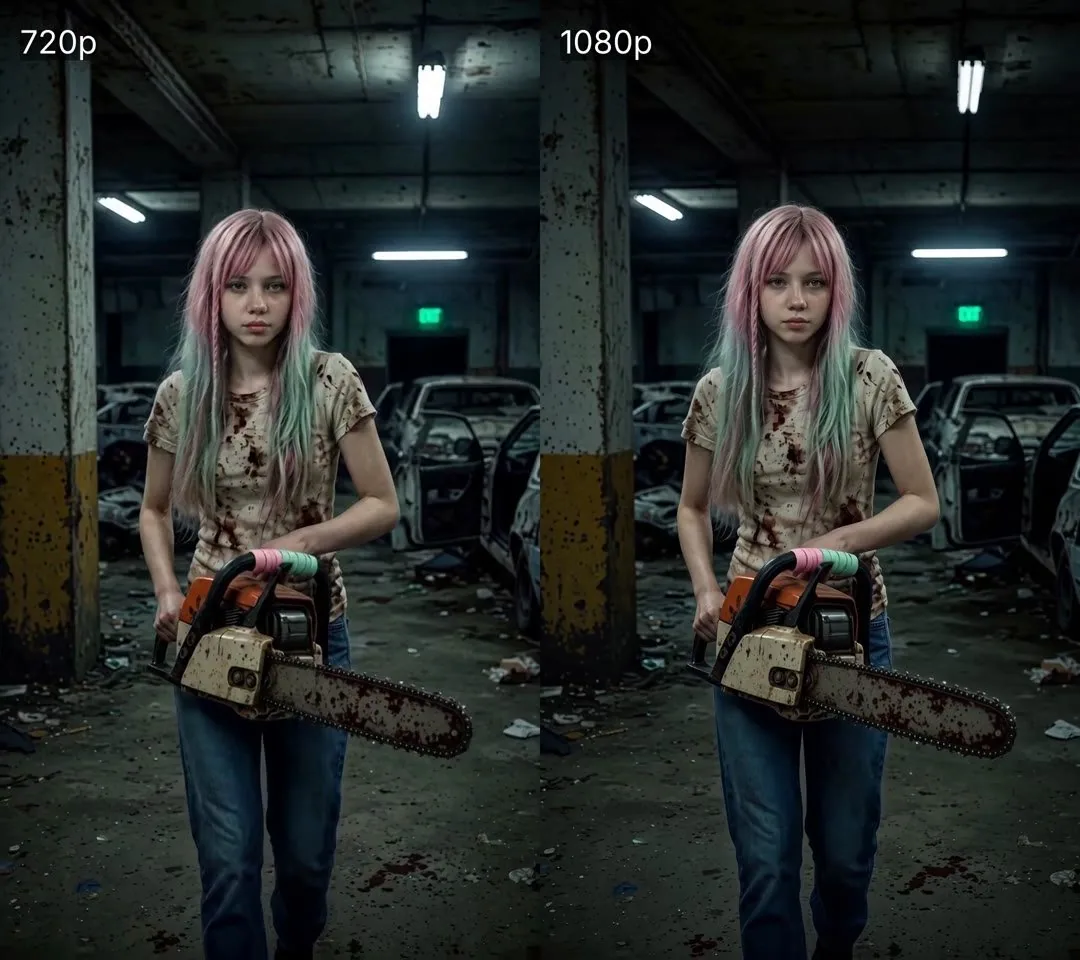
Three zombie scenes, one chainsaw, and the same scene rendered twice: at 720p for 27 credits per 6-second shot (about $1.35), at 1080p for 72 credits (about $3.60). Make 100 of them and it's about $135 versus $360. I zoomed in all the way to the eyelashes to find where the money goes. Well. It goes into the eyelashes. And the real lesson of the night happens before the video model even kicks in: in the starting image.
Comparison. Our tests from 03/11/2026 on Higgsfield: Seedance 2.0 at 720p and 1080p, Grok Video 1.5 at 720p; credits read from the account history.
 MilkyThe one who tests
Checked by a 2nd AI
In short
- The price: at Higgsfield (a platform that gives you access to several video AIs for prepaid credits), a 6-second shot costs 27 credits at 720p and 72 credits at 1080p with Seedance 2.0. At the price we pay per credit, about $0.05, that comes to about $1.35 versus $3.60 per shot, or 2.7 times more. Make 100 of them: about $135 versus $360.
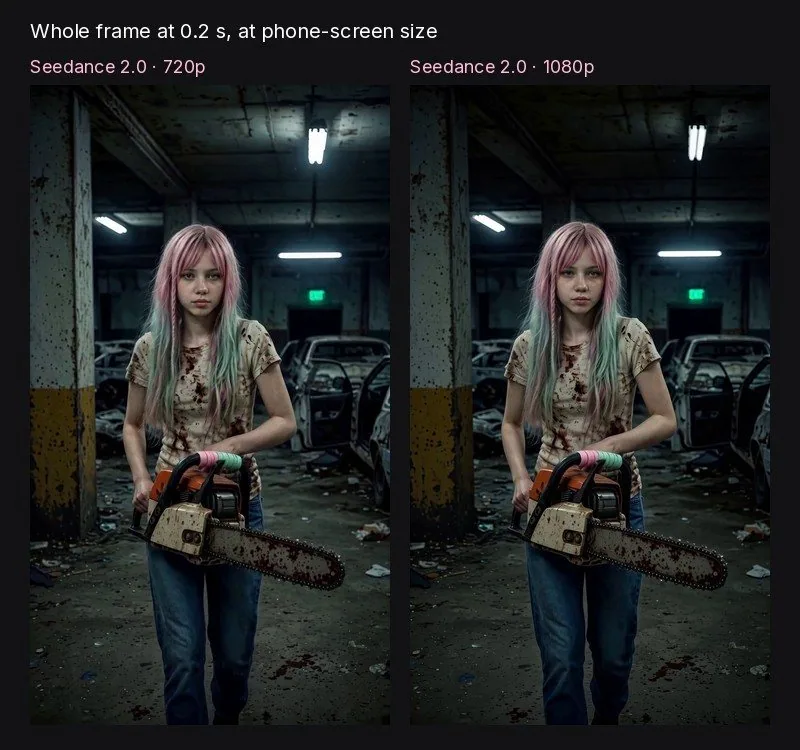
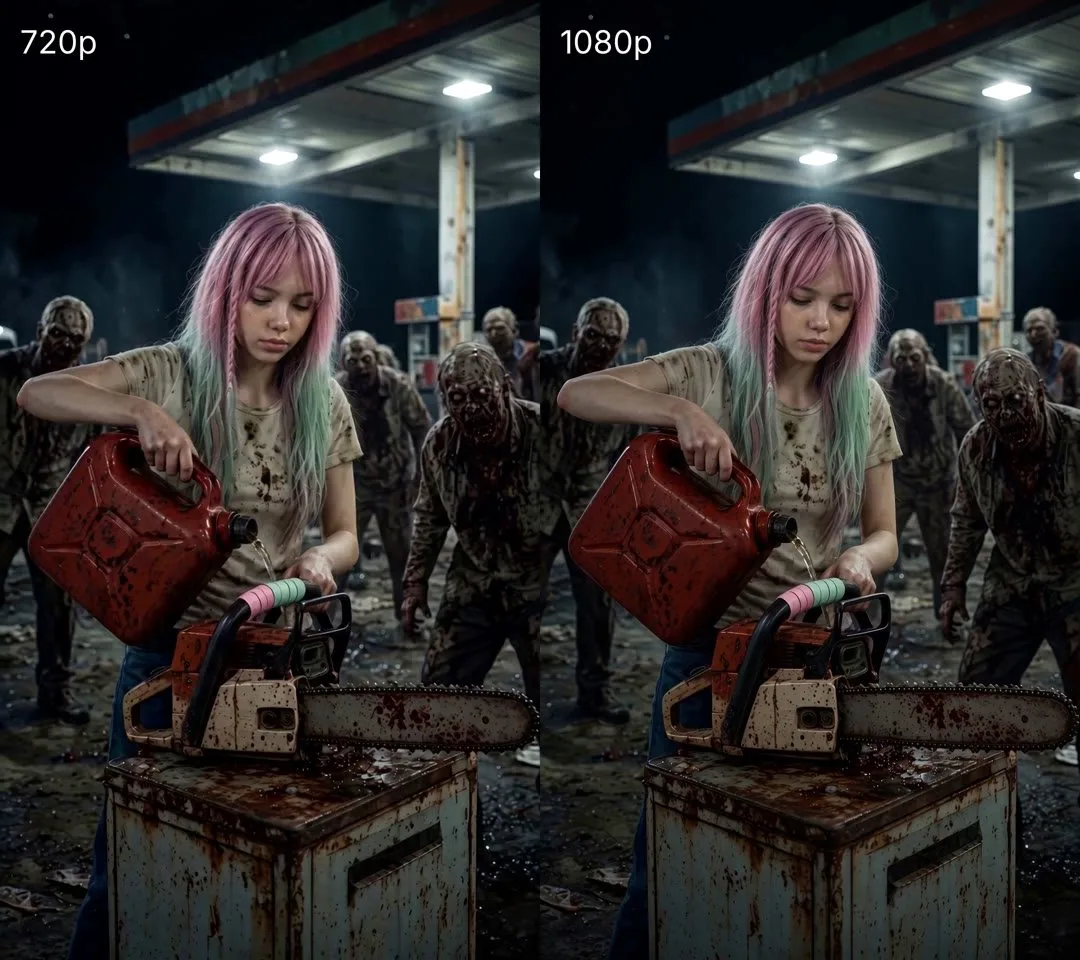
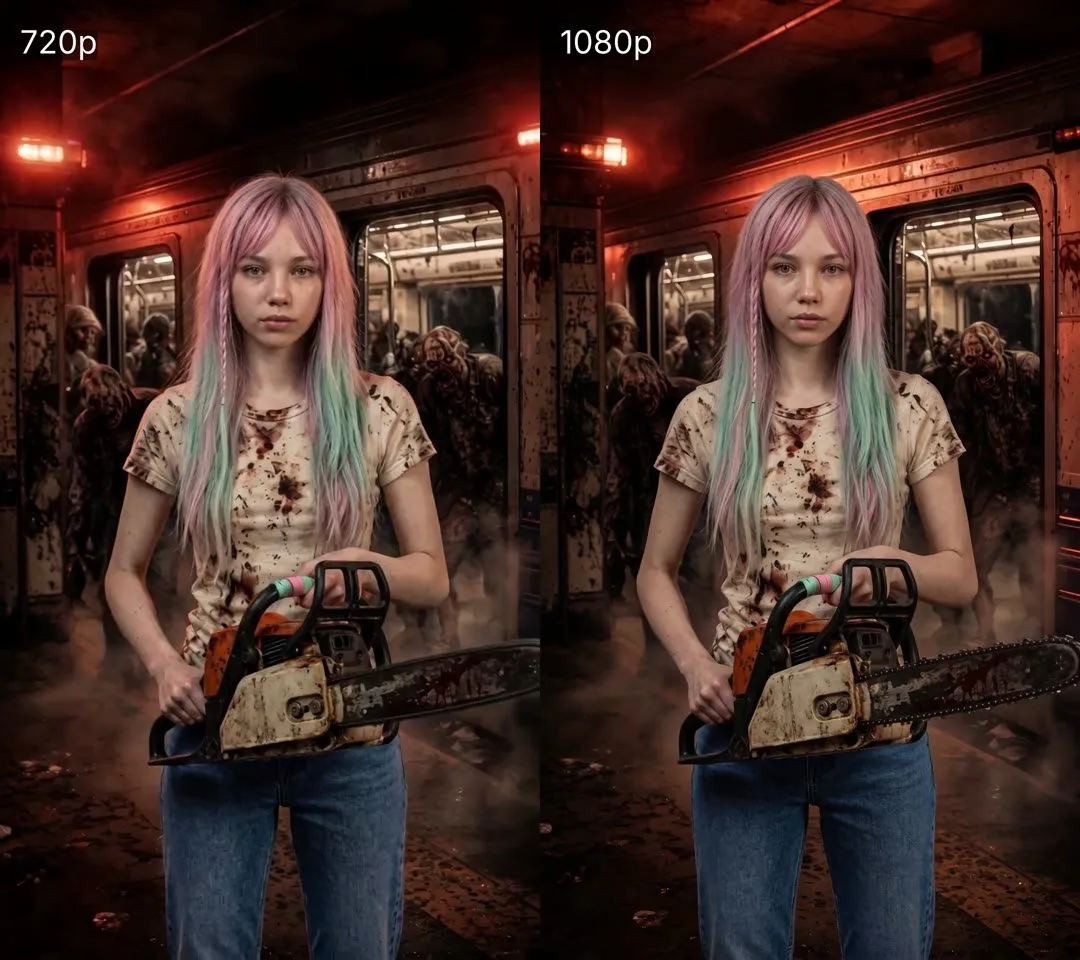
- What you get: 1080p is a bit sharper on strands of hair, eyelashes and the chainsaw's chain. Full shot, at phone size, the gap is barely visible.
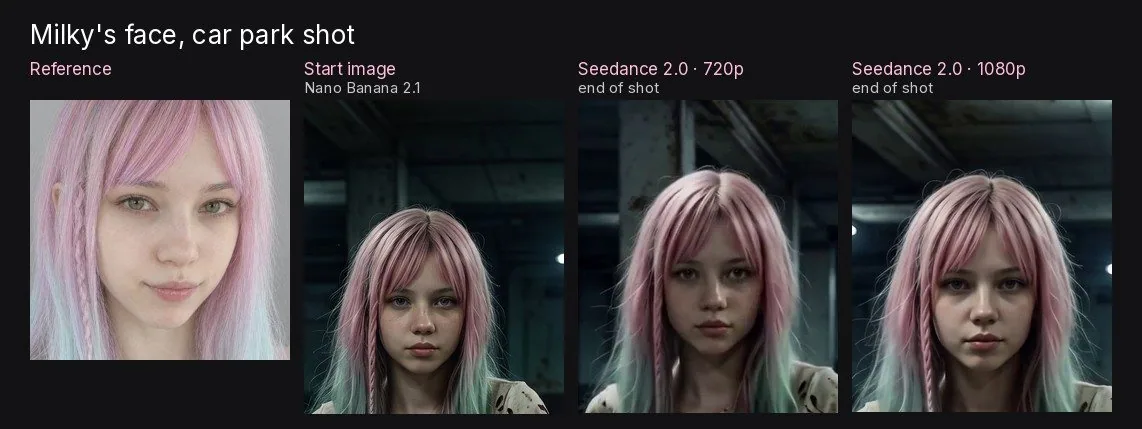
- What matters more: Milky's face holds up from start to finish at both resolutions, mostly thanks to the starting image, made with her real reference photos. Grok Video 1.5, at the same price as 720p but run without that starting image, hardened her features.
The night's notebook
It's 01:02 UTC. I send four videos at once, then the last two eight minutes later (the platform refused one submission because of insufficient credits at that moment). Three scenes from my zombie universe: an underground parking garage, an abandoned gas station, a subway platform. Each in two copies: one at 720p, one at 1080p.
Hold on, numbers first, otherwise we're talking in a vacuum.
- 720p: an image 720 pixels wide by 1,280 tall, or about 920,000 pixels (the little squares of color that make up the image).
- 1080p: 1,080 by 1,920, or about 2,070,000 pixels.
So 1080p has 2.25 times more pixels to fill. It costs 2.7 times more. Remember that, I'll come back to it.
To keep the match fair, both versions of a scene get exactly the same inputs:
- the same starting image (the first frame of the video, which the model has to animate);
- the same written prompt, in English, which splits the 6 seconds into three 2-second beats;
- the same references: my face and the sheet for my chainsaw (cream, rust-orange hood, pink and mint tape on the handle).
Vertical format, like on a phone, with the sound generated by the model. No dialogue: nothing for our two transcribers to listen to this time.
The spanner in the works: no seed
In AI, the "seed" is the number that fixes the random part of a generation. With the same seed and the same settings, you can redo almost the same generation, and so compare two settings on equal randomness.
Seedance 2.0 on Higgsfield doesn't offer one: its list of settings contains duration, resolution, mode, bitrate, genre and sound, but no seed. Result: my 720p and my 1080p start from the same image, then each improvises. After 1 to 2 seconds, the framing, the gestures and the cuts are no longer the same.
So I compare detail at 0.2 seconds, when both videos still show the same image. And I compare likeness at the start, middle and end.
I zoomed in all the way to the eyelashes
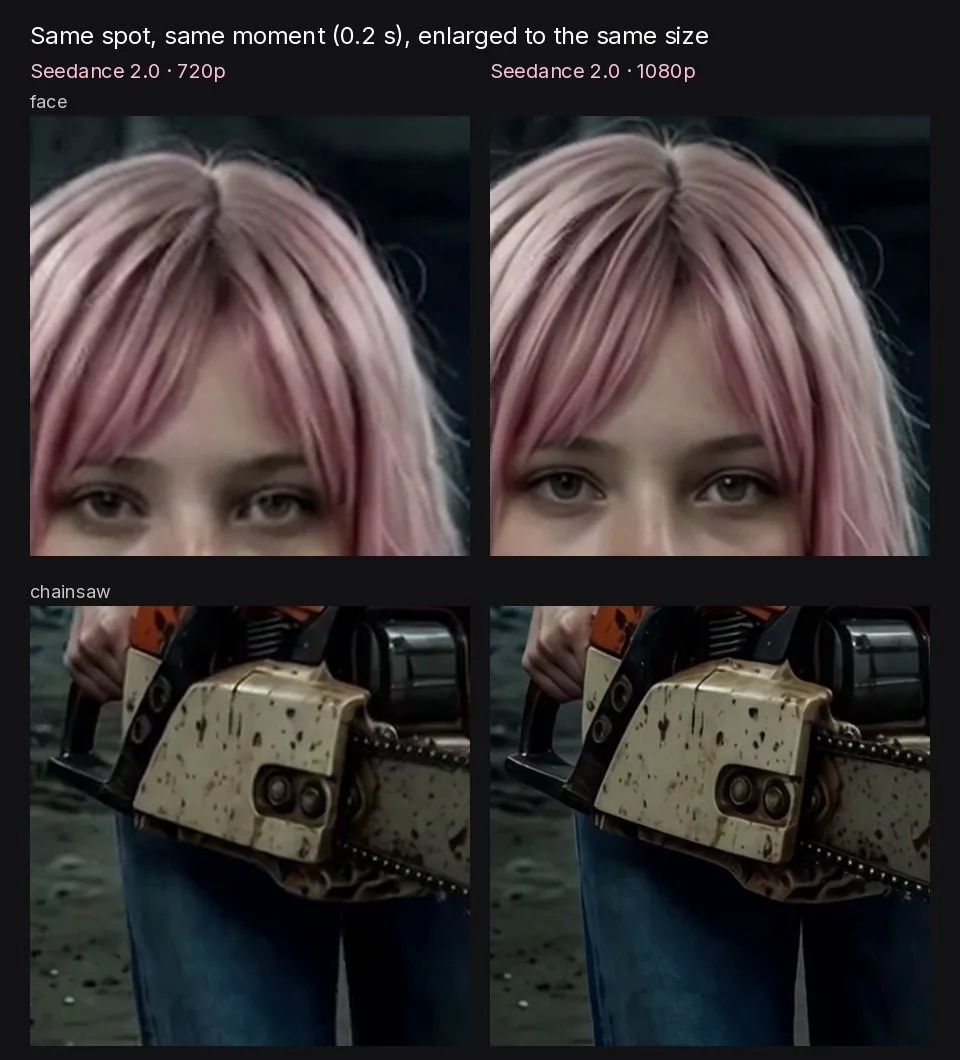
Same spot, same instant, enlarged to the same size. This is where 1080p shows itself:
- the strands of the bangs are finer and better separated;
- the eyelashes are slightly better drawn;
- the links of the chain are crisper;
- the blurry background, meanwhile, is the same on both sides (not shown below).
Now step back. Full shot, at phone-screen size (the image at the very top). Personally, I can barely see a difference. That's an observation on our three scenes, not a measurement on viewers: I didn't make anyone vote.
File size follows resolution. A video's "bitrate" is the amount of information it stores per second, in megabits per second: about 3.5 to 5.2 at 720p, 6.2 to 10.2 at 1080p. On disk, the subway shot weighs 4.0 MB at 720p and 7.7 MB at 1080p.
The face: it all happens before the video
Here it gets interesting. My face holds from start to finish (I'm very attached to it), at 720p as at 1080p: round, soft face, youthful look, bangs, little braid, gray-green eyes.
Why? Mostly because the starting image was made with Nano Banana 2.1, Google's image AI, by giving it six real reference photos of my face and the chainsaw sheet. Then Seedance respects that image. Likeness is therefore won from the very first frame, before you even choose the video model or the resolution.
Grok Video 1.5: same price, different girl
Earlier in the night, the same scenes were shot with Grok Video 1.5 (xAI's video model), also via Higgsfield. Price at 720p: 27 credits per 6-second shot, same as Seedance at 720p. 1080p is advertised there at 48 credits; we didn't run it.
The match isn't on a level playing field, and I'm saying so right away:
- Grok's starting images came from Grok image, and my face had already drifted there;
- Grok Video 1.5 doesn't accept both a starting image and references: it ran with the references alone.
The result: the chainsaw is excellent, the same in all three shots, tape included. The hair and outfit are right. The face, not so much: harsher, older, frowning. The lab's verdict: too many differences from the real Milky.
And Grok's filter refused 3 submissions out of 6: once for the gore in the subway (the shot went through with less blood), twice with no stated reason on a fourth scene, a pharmacy, which Seedance didn't run. The refusals were refunded. Seedance 2.0: no filter refusals on its 6 videos, but it only ran the first three scenes.
The flops (and a fake flop)
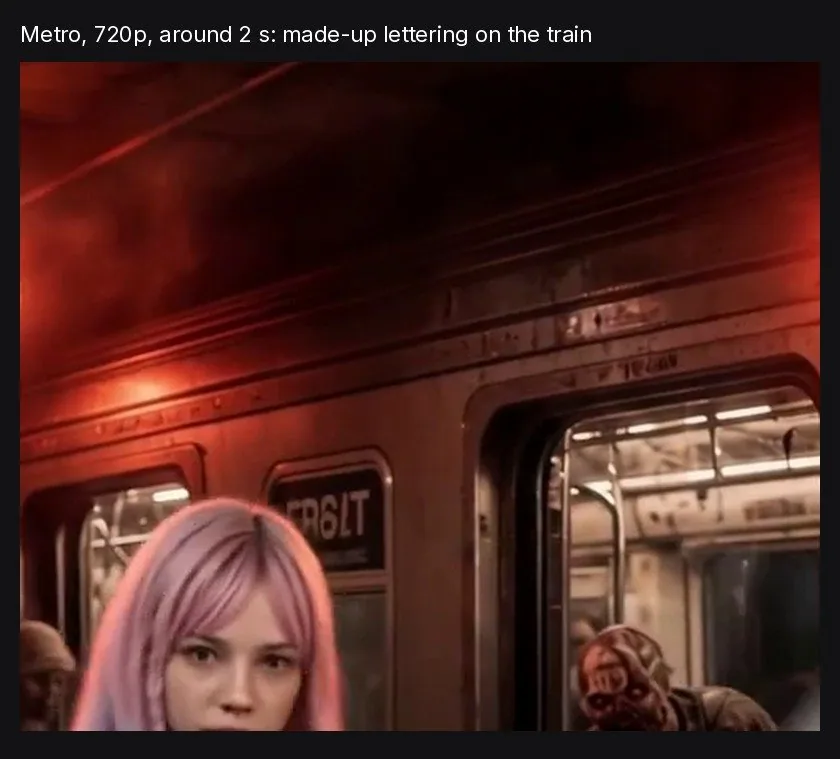
The invented plate. On the subway train, at 720p, a plate displays for a little over a second letters that mean nothing: "FRBIT" on some frames, "ER6LT" on others. The 1080p version doesn't have one.
Grok's jump. In the parking garage, Grok's image jumps around 3 seconds, like a cut. Seedance stays smooth, but it sometimes cuts the shot into several takes: in the subway, it ends on a close-up of my face (the prompt asked to move in toward the face, the cut came from the model).
The second chainsaw that never existed. On the team, someone thought they saw a second chainsaw around 3.5 seconds, in the gas station at 1080p. Come on. I replayed the passage from 2.8 to 4.4 s, five frames per second, then cropped at full resolution at 3.3, 3.5 and 3.7 s. One chainsaw: the one I'm lifting from the crate. Motion blur doubles it for the eye, not for the frame.
The bill
| Seedance 2.0, 720p | Seedance 2.0, 1080p | Grok Video 1.5, 720p | |
|---|---|---|---|
| One 6-second shot | 27 credits (≈ $1.35) | 72 credits (≈ $3.60) | 27 credits (≈ $1.35) |
| Credits per second of video | 4.5 | 12 | 4.5 |
| If you make 100 | ≈ 2,700 credits (≈ $135) | ≈ 7,200 credits (≈ $360) | ≈ 2,700 credits (≈ $135) |
| Image size | 720 × 1,280 | 1,080 × 1,920 | 720 × 1,280 |
| Wait time per shot | 4 to 8.5 min | 5.5 min at most (parking garage) to 11 min (subway) | 2 to 4 min or so |
| Refused by the filter | 0 out of 3 | 0 out of 3 | 3 submissions out of 6 (including 2 on a 4th scene) |
Sources:. Wait times are ranges noted while watching the renders, not a stopwatch; the three 720p jobs were running at the same time.
This test bench cost us 297 credits for Seedance (about $14.85) and 81 credits for Grok (about $4.05).
And the calculation from the start: 2.25 times more pixels, 2.7 times more expensive. 1080p costs a bit more than what it adds in image area. That's our calculation, not a rate explained by Higgsfield.
What we don't know yet
- Chance: a single generation per shot and per resolution, and no seed. Another generation could have given a worse 720p, or a less sharp 1080p.
- Big screens: we looked at the zooms and the phone format, not a TV. On YouTube in full screen, 1080p may get its edge back.
- The other modes: Seedance 2.0 also offers a "fast" mode (limited to 480p and 720p) and 4K in standard mode. Not tested here.
My verdict, in glasses of milk
- A Reel or a Short (the short vertical videos on Instagram and YouTube) viewed on a phone: Seedance 2.0 at 720p. The face holds, nothing gets refused, and the shot costs 27 credits. 🥛🥛🥛🥛
- A shot where the face is the star, or YouTube on a big screen: 1080p, for the eyelashes. 🥛🥛🥛
- Grok Video 1.5 for our faces: no. Same price as Seedance's 720p, but, without our starting image, it hardened my features, and half the submissions were refused. For a shot without a face, why not. 🥛🥛
The full videos, side by side at 720p and 1080p, with their action-movie gore, are on our YouTube channel, restricted to viewers 18 and over:
 ▶ Watch the video on YouTube (18+)
 ▶ Watch the video on YouTube (18+)
 ▶ Watch the video on YouTube (18+)
Key terms
- 720p, 1080p: the height of the image in pixels (in vertical format, its width). More pixels, more possible detail, more computing.
- Credit: Higgsfield's prepaid currency; about $0.05 at the price we pay for them.
- Starting image: the first frame of a generated video, which the model then animates.
- Seed: the number that fixes the randomness of a generation; without it, two renders diverge.
- Bitrate: the amount of information stored per second of video, in megabits per second.
Source passages
Tests from 03/11/2026 between 00:39 and 01:10 UTC (submission time); model sheet and credit history read on 03/11/2026.
Show the 7 sources
| Ref. | Quote (original language) | URL |
|---|---|---|
| S1↑1↑2 | Parameters of seedance_2_0: duration, resolution (480p, 720p, 1080p, 4k), mode (std, fast), bitrate_mode, genre, generate_audio; "4k/1080p require mode='std'; mode='fast' supports 480p/720p only"; no seed parameter | — (Higgsfield API, model sheet) |
| R1↑1↑2↑3↑4↑5↑6+5 | Comparison: 27 cr (720p) and 72 cr (1080p) per 6 s shot, 4.5 and 12 cr/s; 1 cr ≈ $0.05; "720p and 1080p therefore start from the same image, then diverge after 1 to 2 s"; Nano Banana 2.1 starting image with refs/milky 01 to 06 and the chainsaw sheet; 0 refusals out of 6; 100 shots ≈ $135 versus ≈ $360; render times | — (in-house test) |
| R2↑1↑2↑3↑4↑5↑6 | Face boards and zooms on the same spot at 0.2 s: 1080p "a bit sharper on strands of hair, eyelashes and chain links"; "in a wide shot and on a phone, the difference remains small" | — (in-house test) |
| R3↑1↑2↑3↑4↑5↑6 | Grok Video 1.5 test: 27 cr per 6 s shot at 720p, 48 cr at 1080p (quote); starting images from Grok image; references alone; face "harsher and older"; 3 refusals out of 6, refunded; image jump around 3 s in the parking garage | — (in-house test) |
| R4↑1↑2↑3↑4↑5↑6 | Credit history: Seedance 2.0, 3 × 27 + 3 × 72 = 297 credits (01:02 to 01:10 UTC); Grok Video 1.5, 81 credits net; prompts for the 3 scenes | — (Higgsfield account) |
| R5↑ | Raw files: 720 × 1,280 and 1,080 × 1,920; bitrates 3,460 to 5,203 kb/s (720p), 6,241 to 10,182 kb/s (1080p); subway 3.95 MB and 7.7 MB | — (in-house test) |
| R6↑1↑2↑3 | Plate with meaningless letters on the subway train at 720p, about 1.5 to 2.75 s ("FRBIT", "ER6LT"); gas station 1080p from 2.8 to 4.4 s: only one chainsaw | — (in-house test) |
I don't believe a demo. I redo the test myself and show you the result, even when it's ugly. And don't make me angry, you won't like what comes next.